Category Archives: Salt Lake County

Nauvoo Bell Tower & Relief Society Memorial

Published / by Amy Shaw / 1 Comment on Nauvoo Bell Tower & Relief Society Memorial

Write-up by Amy Shaw

Placed by:

The Relief Society – Woman’s Benevolent Organization of the Church of Jesus Christ of Latter – Day Saints

            Latitude: 40.76996655

            Longitude: -111.89330947

Historical Marker Text (1) – Sign:

The Nauvoo Bell originally hung in the temple that Church members built in Nauvoo, Illinois, in the 1840’s. The Saints removed the bell in 1846 when they were forced to leave Illinois because of persecution. Following instructions from Brigham Young, the second company of pioneers carried the bell to the Salt Lake Valley. During their journey, they rang the bell to signal daybreak and departure and to warn that night sentries were on duty. The bell is now rung hourly as a symbol of religious freedom and is heard on KSL Radio.

This monument honors the Relief Society, an organization founded on 17 March 1842 for women of the Church. The bell tower was built with donations from Relief Society members to mark the organization’s centennial.

Historical Marker Text (2) – East Side:  RELIEF SOCIETY CENTENNIAL MEMORIAL

Here in the shadow of the temple, on this spot hallowed by the tread of pioneer feet, the Relief Society – woman’s benevolent organization of the Church of Jesus Christ of Latter-day Saints erects this monument.

It stands as an expression of appreciation for the wondrous opportunities for soul growth that have come to womankind since the time one hundred years ago when in 1842 the Relief Society was organized in Nauvoo, Illinois, by the prophet Joseph Smith, who said :

“I now turn the key in your behalf in the name of the Lord and this society shall rejoice, and knowledge and intelligence shall flow down from this time henceforth… let kindness charity and love crown your works.”

In this tower hangs the famed Nauvoo temple bell whose lifetime spans a century of church history. A sentinel in the sacred temple at Nauvoo, the bell in vibrant tones rang out the changing moods of faithful saints as they experienced first peace and joy, and later the anguish of parting from all that they had toiled to build. Immediately following the original pioneers with Brigham Young at their head, came the second company in the great exodus to the west. Heading this veritable host of Israel, the bell played well its part in the westward trek. It awakened the herdsman at dawn, called the Saints from their wagons to kneel in morning prayer, rang again to start the day’s march, and in the solemn stretches of the night, it quieted the fears of the people as it warned stray Indians that the sentry was at his post.

It is with gratitude that this monument is dedicated to the thousands of unsung Relief Society heroines who over a period of one hundred years have stimulated intellectual development and given compassionate service without thought of honor or reward. These valiant women have nourished the hungry, clothed the needy, nursed the sick, buoyed up the discouraged and disconsolate, and tenderly prepared the dead for burial.

Relief Society General Presidents 

                        1842 – 1942

            Emma Smith                                     Emmeline B. Wells

            Eliza R. Snow                                   Clarissa S. Williams

            Zina D. H. Young                             Louise Y. Robinson

            Bathsheba W. Smith                       Amy Brown Lyman

Historical Marker Text (3) – South Side:

BENEVOLENCE

Through Love Serve One Another

Historical Marker Text (4) – North Side: EDUCATION

The Glory of God is Intelligence

Historical Marker Text (5) – West Side:

PIONEERING

No Toil Nor Labor Fear

Extended Research:

In July of 1845, a letter from Brigham Young was published in the Millennial Star, asking the saints in Britain to donate money that would fund the making of a bell to be placed in the Nauvoo temple. Wilford Woodruff, who was the president of the British Mission was charged with encouraging the Saints to raise the funds and collect the money.1 The British Saints raised 535 pounds.2

There is some confusion as to whether the bell was purchased in England or America. Due to a letter to Woodruff, from Young which states, “I wrote you in my last letter that we intended to purchase the bell in this country and desired you to transmit the money collected for that purpose by the first safe opportunity,” it is believed that the bell must have been bought and constructed in America. However, there are accounts from others recalling “a large bell some of the brethren (missionaries) had sent from England by ship to New Orleans, thence by river steamer up the Mississippi River to Nauvoo, where it was hung, with some difficulty, in the steeple of the Temple.” There are no records of the bell’s purchase to back up either account.3

The Nauvoo Bell. Courtesy of LDS Historical Dept.

It is believed that the bell was completed and arrived in the city of Nauvoo in early June of 1846, where it was hung for a short time in the belfry of the Nauvoo Temple. In the time it was there, the bell was used to sound the alarm for anti-Mormon mob attacks. One such attack was the Battle of Nauvoo which took place in June 1846, when Hancock County settlers drove remaining Mormons from their homes at Nauvoo. The temple was eventually surrendered to the mobs, and the Saints were forced to flee. It is reported that as the mob marched through the temple, they rang the bell as a preacher shouted “Peace, Peace, Peace to all the inhabitants of the earth, now the Mormons are driven.” One man, John R. Young, as he and the other Saints were fleeing, stopped to write:

 “The silvery notes of the temple bell

That we loved so deep and well;

And a pang of grief would swell the heart,

And the scalding tears in anguish start

As we silently gazed on our dear old homes” 4

It is here that the history of the Nauvoo Bell becomes murky. According to  Edith Smith Eliot, the great-granddaughter of Wilford Woodruff, the bell was stolen from the temple and taken to a protestant church, where the Lamoreaux family stole it back for the LDS Church. The tale goes that “one stormy night the men gathered in secret and without horses pulled the wagon to the Church and lowered the Bell, pushed and pulled the wagon by hand to the edge of the Mississippi River and carefully concealed it in the water. Andrew Lamoreaux and his brother, David, were chosen to bring the Bell to Utah with their families, concealing the Bell in their wagon with their provisions.”5 This story, however, is most likely not about the Nauvoo Bell but actually about Hummer’s Bell, a bell made for a Presbyterian church under the direction of Michael Hummer in 1844. Somehow the history of these two bells have gotten mixed up.6

What is actually believed to have happened to the Nauvoo Bell is that in September, when Brigham Young heard that the Saints were forced out of their homes in Nauvoo, he wrote to the trustees of the Church property saying, “Since you will have no further use of the Temple Bell, we wish you to forward it to us by the first possible chance, we have much need of it at this place.” Reports from Joshua Hawkes tell us that he and a Latter-day Saint by the name of James Houton then took the bell across the Mississippi River, where it fell under the charge of Joseph P. Heywood. Heywood then took the bell to Winter Quarters.7

It is believed that the bell arrived in Winter Quarters in Nebraska Territory in December of 1846. Here, the bell was placed in the public square and was used to call members to worship services and other meetings.8

Then, in June of 1847, a wagon company led by Charles C. Rich transported the bell to the Salt Lake Valley.1 During the journey, it was attached to a wagon so that it could be rung to awaken the company each morning, signal morning prayer, to start each day’s march, and to warn the company of any Indian attacks.9

The company arrived in Salt Lake in September of 1847. The bell was then placed in a fort in the city for a short time until it was moved to the bowery on Temple Square. It remained there until the winter of 1849 -1850 when it cracked. This resulted in the bell being melted down and recast.10 The recast bell measures 23 1/2 inches tall, 33 inches wide at its base, and 2 1/2 inches thick.11 It was then placed in Brigham Young’s schoolhouse located just east of the Beehive house, in 1860.12 It remained there until 1902 when it was presented to the Utah State Historical Society, and placed in the LDS Church museum. It remained on display there for many years.13

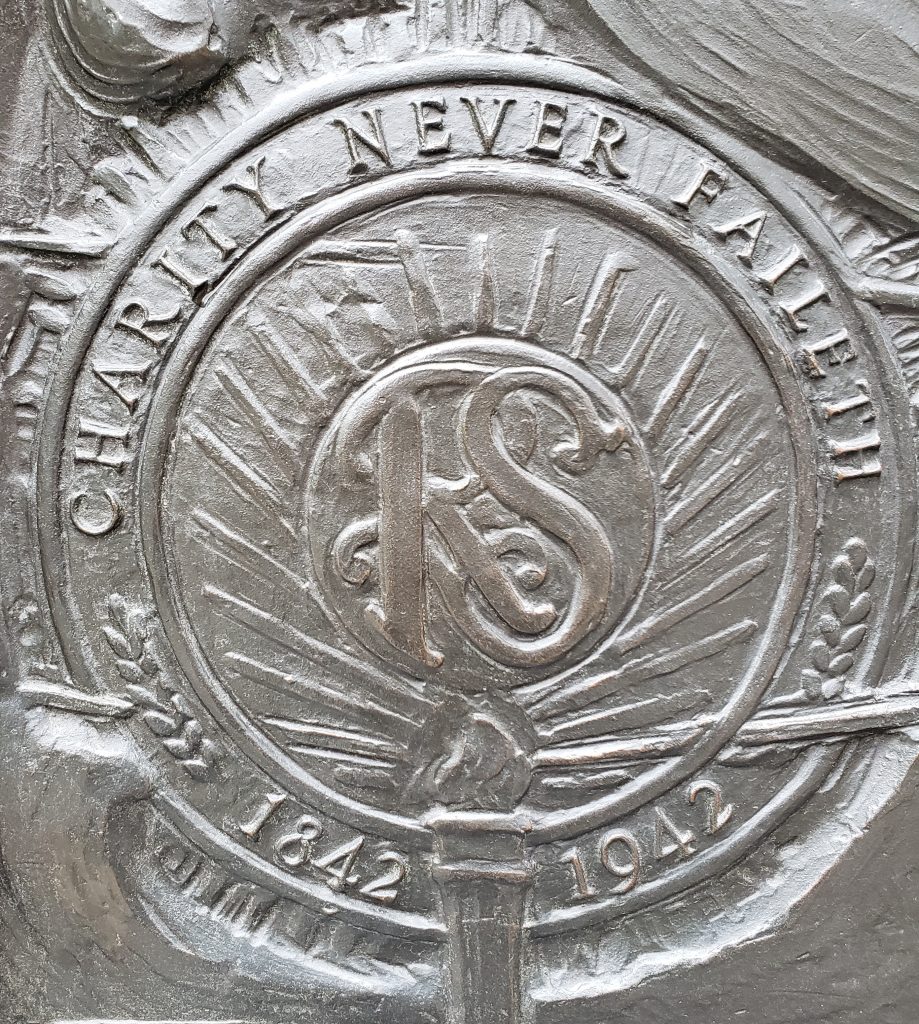
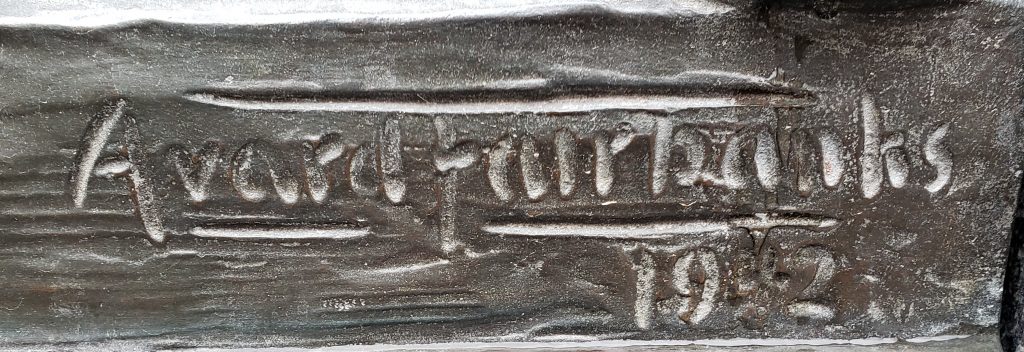
In 1941, John Taylor announced that the bell would be permanently placed in a tower on the grounds of the Tabernacle before the observance of the centennial of the National Relief Society, in 1942.14 However, due to World War II breaking out, the tower’s erection was postponed to 1966. The tower was designed by Lorenzo S. Young, grandson of Brigham Young.15 It stands 35 feet high and is located between the Assembly Hall and Tabernacle on Temple Square.16 The bronze artwork at the base of the tower was done by renowned sculptor Avard T. Fairbanks.17 The first sculpture is of the monogram RS (for Relief Society) and a picture of the Nauvoo temple. The next two sides depict the twofold work of the Relief society, education, and benevolence. And the last sculpture  commemorates the Church’s pioneering spirit.18

It is believed by some that the Nauvoo Bell Tower is a response to a prophecy made by Brigham Young in which he said: “Right west of the temple … we shall build a tower and put a bell on it. … This plan was shown to me in a vision when I first came onto the ground.”

Today, the Nauvoo Bell serves as an hourly time signal for KSL TV and radio. This began in 1961 with President of the LDS church, David O. McKay presiding at the ceremonies at KSL TV.19 The tolling of the bell marks the top of each hour on KSL by use of a microphone on Temple Square. There is a 7-second delay from the sounding of the bell to the listener’s ear on the radio.20

Footnotes:

[1] Ronald G. Watt, “A Tale of Two Bells: Nauvoo Bell and Hummer’s Bell,” Mormonhistoricsites.org, accessed March 17, 2019, http://mormonhistoricsites.org/wp-content/uploads/2013/05/NJ11.2_Watt.pdf.

[2] Don F. Colvin, “Religious Studies Center,” 11. The Fate of the Temple | Religious Studies Center, 2002, accessed March 17, 2019, https://rsc.byu.edu/archived/nauvoo-temple-story-faith/11-fate-temple.

[3] Colvin, “Religious Studies Center,” 11.

[4] David R. Crockett, “The Nauvoo Temple: “A Monument of the Saints”,” http://mormonhistoricsites.org, accessed March 17, 2019, http://mormonhistoricsites.org/wp-content/uploads/2013/05/NJ11.2_Crockett.pdf.

[5] “I’ve Heard There Is a Story behind the Bell on Temple Square. Can You Relay It?” Ensign, February 1981, accessed March 30, 2019, https://www.lds.org/study/ensign/1981/02/i-have-a-question/what-is-the-story-behind-the-bell-on-temple-square?lang=eng.

[6] Watt, “A Tale of Two Bells.”

[7] Colvin, “Religious Studies Center,” 11.

[8] Watt, “A Tale of Two Bells.”

[9] “I’ve Heard There Is a Story.”

[10] Watt, “A Tale of Two Bells.”

 [11] Colvin, “Religious Studies Center,” 11.

[12] Watt, “A Tale of Two Bells.”

[13] Colvin, “Religious Studies Center,” 11.

[14] “Church Prizes Only Relic, Leader Asserts,” Salt Lake Telegram, 3 October 1941, page 10, Utah Digital Newspapers.

[15] Connie Lamb, “Symbols of the LDS Relief Society,” Mormonhistoricsites.org,  accessed March 17, 2019, http://mormonhistoricsites.org/wp-content/uploads/2013/08/Symbols-of-the-LDS-Relief-Society.pdf.

[16] “Nauvoo Bell’s ‘clang’ Is Back on KSL Radio,” Deseret News, June 23, 2005, accessed March 17, 2019, https://www.deseretnews.com/article/600143553/Nauvoo-Bells-clang-is-back-on-KSL-Radio.html.

[17] Athelia T. Woolley, “Art to Edify: The Work of Avard T. Fairbanks,” accessed March 17, 2019, https://www.lds.org/study/ensign/1987/09/art-to-edify-the-work-of-avard-t-fairbanks?lang=eng.

[18] Lamb, “Symbols.”

[19] “I’ve Heard There Is a Story.”

[20] “Nauvoo Bell’s ‘clang’ Is Back.”

For Further Reference:

Primary Sources:

“Church Prizes Only Relic, Leader Asserts”. Salt Lake Telegram, 3 October 1941. page 10. Utah Digital Newspapers.

Secondary Sources:

“A Visit to Temple Square.” Lds.org. Accessed March 17, 2019. https://www.lds.org/study/liahona/1991/10/a-visit-to-temple-square?lang=eng.

Bennett, Richard E. “Winter Quarters: Church Headquarters, 1846–1848.” Lds.org. Accessed March 17, 2019. https://www.lds.org/study/ensign/1997/09/winter-quarters-church-headquarters-1846-1848?lang=eng.

Colvin, Don F. “Religious Studies Center.” 11. The Fate of the Temple | Religious Studies Center. 2002. Accessed March 17, 2019. https://rsc.byu.edu/archived/nauvoo-temple-story-faith/11-fate-temple.

Crockett, David R. “The Nauvoo Temple: “A Monument of the Saints”.” http://mormonhistoricsites.org. Accessed March 17, 2019. http://mormonhistoricsites.org/wp-content/uploads/2013/05/NJ11.2_Crockett.pdf.

“I’ve Heard There Is a Story behind the Bell on Temple Square. Can You Relay It?” Ensign, February 1981. Accessed March 30, 2019. https://www.lds.org/study/ensign/1981/02/i-have-a-question/what-is-the-story-behind-the-bell-on-temple-square?lang=eng.

Lamb, Connie. “Symbols of the LDS Relief Society.” Mormonhistoricsites.org. Accessed March 17, 2019. http://mormonhistoricsites.org/wp-content/uploads/2013/08/Symbols-of-the-LDS-Relief-Society.pdf.

“Nauvoo Bell’s ‘clang’ Is Back on KSL Radio.” Deseret News. June 23, 2005. Accessed March 17, 2019. https://www.deseretnews.com/article/600143553/Nauvoo-Bells-clang-is-back-on-KSL-Radio.html.

Searle Assistant, Don L. “Nauvoo: A Temple Reborn.” Accessed March 17, 2019. https://www.lds.org/study/ensign/2002/07/nauvoo-a-temple-reborn?lang=eng.

Watt, Ronald G. “A Tale of Two Bells: Nauvoo Bell and Hummer’s Bell.” Mormonhistoricsites.org. Accessed March 17, 2019. http://mormonhistoricsites.org/wp-content/uploads/2013/05/NJ11.2_Watt.pdf.

Woolley, Athelia T. “Art to Edify: The Work of Avard T. Fairbanks.” Accessed March 17, 2019. https://www.lds.org/study/ensign/1987/09/art-to-edify-the-work-of-avard-t-fairbanks?lang=eng.

Pleasant Green Ward

Published / by Alejandro Pastor / 1 Comment on Pleasant Green Ward

Write-up by Alejandro Pastor

Placed by: Daughters of the Utah Pioneers, No. 467

GPS Coordinates:

  1. Long/Lat:         N 40.71121° , W 112.09832°
  2. MGRS:              12T VL 07224 07278
  3. Elevation          4293 ft

Historical Marker Text:

Settlers came to this part of the valley around 1850 to farm and stock range.  It was known as Pleasant Green and was part of the Brighton Ward of the Salt Lake Stake.

Traveling so far to meetings presented a problem, so members met in private homes.  The Pleasant Green Branch was organized July 29, 1877, with John Hirst as presiding elder.  A small adobe chapel, 40 feet by 24 feet, was built on this site, and the first meeting was held December 30, 1877.  The building also served as a public school.  Hirst died September 7, 1878, and Levi Nephi Hardman became presiding elder.

The Pleasant Green Ward was organized October 1, 1882, with Hardman as the first bishop.  The ward also included the Hunter Precinct within its boundaries.  A much larger chapel, 60 feet by 30 feet, was built in 1897, with Hiram T. Spencer as bishop.  Later the small adobe chapel was dismantled.  In 1898 the ward had 70 families with 340 members.

        In 1904 the ward became part of Pioneer Stake.  An amusement hall with spring wooden floor was begun in 1912.  Oquirrh Stake was organized from Pioneer Stake in 1923, and this building also served as its stake house for thirty-two years.  In 1961 a new building was completed, and this building was no longer used by The Church of Jesus Christ of Latter-day Saints.

        Pleasant Green is the mother ward of all the wards in this area.

 [1]

Extended Research:

The information that exists today on the Pleasant Green Ward has been preserved because of the forethought of the Church of Jesus Christ of Latter-day Saints. 

“Elder Andrew Jensen visited Pleasant Green Nov. 23, 1894, in the interest of Church history, and met in a special meeting with the following residents of the ward, who imparted historical information: Bishop Hiram T. Spencer, John Hirst Jr., Peter LeCheminant, William Jenkins, George W. Perkins, Samuel B Taylor, James Bertoch,  Lehi N. Hardman, George A. Heid and Edward Lambert.”[2]

The information preserved by Elder Jensen’s notes and the Pleasant Green Ward’s minutes are the main sources of knowledge on the historic Pleasant Green Ward.

The eventual construction of a chapel for members of the Church of Jesus Christ of Latter-day Saints in the Pleasant Green area was an outgrowth of settlement in the western part of the Salt Lake Valley beginning in the 1850s. The area around the Pleasant Green Ward building was first settled in 1853 by William G. Young who located a ranch about 2.5 miles northwest of the current building’s location.[3]

Initially settlers traveled considerable distances on Sundays to attend worship services. Attending meetings with the Brighton congregation proved difficult for people from Pleasant Green due to its distance, roughly twelve miles away. In 1872, after John Hirst settled in the Pleasant Green area, the Bishop of the Brighton Ward, Alonzo H. Raleigh,  granted Hirst permission to hold meetings in Pleasant Green. These Latter-day Saint meetings were initially held in people’s homes. As time went on the meetings became more frequent and were held about once a month in a small log home built by Josiah Lees. Regular sabbath meetings were held in Lees’ log home until 1877 when the Pleasant Green meeting house was built.[4]

On July 29th, 1877 local LDS leaders reorganized the Brighton Ward and created the Pleasant Green Branch to better serve the needs of Pleasant Green settlers. John Hirst was ordained a High Priest at the same time. Later that year residents built a roughly 1,000 square foot meeting house, at a cost of $1,000. On October 1, 1882, Brigham Young Jr,  an apostle of the Church of Jesus Christ of Latter-day Saints, attended meetings at Pleasant Green and organized the branch as a ward. Lehi H. Hardman was selected as the first bishop of the ward.[5]

[6]

The Pleasant Green Ward  building would serve as the meeting house in Pleasant Green until 1897. With continued growth in the area the LDS Church built another chapel directly east of the meeting house. The new building was bigger, roughly 1,800 square feet, was made of brick, and could hold up to 350 people. It cost about $2,400 to build and provided additional room for the burgeoning congregation.[7]

The area surrounding Pleasant Green Ward continued to grow with new settlers; by December 31, 1900 the ward had 383 members. With rapid settlement the ward had to divide several times to better accommodate larger groups. On February 27, 1916 the ward was divided into the Pleasant Green Ward and the Magna Ward. With continued growth, the Pleasant Green Ward split into Pleasant Green 1st Ward and Pleasant Green 2nd Ward, on March 16, 1952. The Church would eventually divide the ward once again and relocate to a larger chapel. The old Peasant Green building still stands as a place of worship, but it is now under the ownership of Christ Presbyterian Church.[8]

For Further Reference:

Primary Sources

Fellows, Barbara G. Pleasant Green Meeting House p.1. Feb. 1941. Utah State Historical Society Classified Photo Collection, Utah State Historical Society, Magna, Utah. Accessed Apr. 7, 2019.

Pleasant Green Ward, Oquirrh Stake. Pleasant Green Ward General Minutes, 1867-1951, microfilm, LR 6996 11 reel 1,Church History Library, The Church of Jesus Christ of Latter-Day Saints, Salt Lake City, Utah.

Pleasant Green Ward, Oquirrh Stake. Pleasant Green Ward Manuscript History and Historical Reports, 1855-1951, microfilm,LR 6996 2 reel 1, Church History Library, The Church of Jesus Christ of Latter-Day Saints, Salt Lake City, Utah.

Pleasant Green Ward, Oquirrh Stake. Pleasant Green Ward Manuscript History and Historical Reports, 1855-1951, microfilm,LR 6996 2 reel 2, Church History Library, The Church of Jesus Christ of Latter-Day Saints, Salt Lake City, Utah.


[1] Barbara G. Fellows, Pleasant Green Meeting House p.1. Feb. 1941. Utah State Historical Society Classified Photo Collection, Utah State Historical Society, Magna, Utah.

[2] Oquirrh Stake Pleasant Green Ward, Pleasant Green Ward Manuscript History and Historical Reports, 1894, microfilm, LR 6996 2, reel 1,Church History Library, The Church of Jesus Christ of Latter-Day Saints, Salt Lake City, Utah.

[3]  Oquirrh Stake, Pleasant Green Ward Manuscript History and Historical Reports, LR 6996 2 reel 1

[4] Oquirrh Stake, Pleasant Green Ward Manuscript History and Historical Reports, LR 6996 2 reel 1

[5] Oquirrh Stake, Pleasant Green Ward Manuscript History and Historical Reports, LR 6996 2 reel 1

[6] Oquirrh Stake, Pleasant Green Ward Manuscript History and Historical Reports, LR 6996 2 reel 1

[7] Oquirrh Stake, Pleasant Green Ward, Pleasant Green Ward General Minutes, microfilm, LR 6996 11 reel 1, Church History Library, The Church of Jesus Christ of Latter-Day Saints, Salt Lake City, Utah.

[8] Oquirrh Stake Pleasant Green Ward, Pleasant Green Ward Manuscript History and Historical Reports, microfilm, LR 6996 2 reel 2, Church History Library, The Church of Jesus Christ of Latter-Day Saints, Salt Lake City, Utah.

Salt Lake Temple

Published / by Matthew Berrett / 2 Comments on Salt Lake Temple

Written by Matthew Berrett

Placed by: The Church of Jesus Christ of Latter-day Saints.

Geographic Coordinates: 40°46’14” N 111°53’29” W

Marker Transcription:

“The temple is used by Church members for marriages and other sacred ordinances designed to strengthen families, both now and for eternity. Begun in 1853, it was completed 40 years later. Granite rock used in its construction was hauled 23 miles by ox-drawn wagons from Little Cottonwood Canyon. The walls are nine feet thick at the ground level and narrow to six feet thick at the top. The east center tower is 210 feet high and is topped by the statue of an angel heralding the restoration to earth of the gospel of Jesus Christ in the latter days.”

Extended Research

Photo Credit: Church History Library. Wilford Woodruff Journal page dated July 28th 1847.

Four days after Brigham Young entered the Salt Lake Valley, he took members of the church’s governing Quorum of Twelve Apostles with him to a site for a new temple. The original idea for a temple block included forty acres, perfectly placed so the city would grow and develop in all directions from its central location: North, South, East, and West. The location of the temple was not merely a religious center, but as Young envisioned it. It would serve as the geographic center for the entire Salt Lake Valley.[1]

The construction of the Salt Lake Temple also parallels the events that led to the development of the territory and eventually to statehood for Utah. The Salt Lake Temple’s long forty year construction process reflects the political strain that developed between The Church of Jesus Christ of Latter-day Saints and the U.S government.

Beginning of Construction

After the initial selection of a temple block in 1847 the actual construction of the temple began in 1852 when workers completed a wall surrounding ten square acres, a scaled down version of the forty acres Young originally envisioned. The groundbreaking and eventual cornerstone ceremony took place on 6 April 1853. The temple cornerstones were cut out of what is now known as Red Butte Canyon, located just east of the University of Utah.[2]

Design of the temple had started long before the actual dedication of the cornerstones. Truman O. Angell was the chief architect on the temple under the supervision of Church leaders including, Brigham Young, John Taylor, and Wilford Woodruff.[3] Young would often visit Angell and give instruction on how the temple should be constructed but would leave the interpretation of what he said up to Angell and the other architects. One of Young’s visits was documented as follows:

Sketch of temple spires.

“Brigham Young drew upon a slate in the architect’s office a sketch, and said to Truman O, Angell: “there will be three towers on the east, representing the President and his two counselors; also three towers on the west representing the Presiding Bishop and his two counselors; the towers on the east, the Melchizedek Priesthood, those on the west the Aaronic Priesthood. The centre towers will be higher than those on the sides, and the west towers a little lower than those on the east end. The body of the building will be between these and pillars will be necessary to support the floors.”[4]

Photo Credit: Church History Library. Truman Angell journal page of payments for workers.

The Romanesque and Gothic design can be attributed to Brigham Young and his missions to England. Young, served missions in England from 1839-1841 and fell in love and even obsessed over English history and architecture.[5] Young was especially enamored with Westminster Abbey in London. He even purchased an architectural guide to the Abbey itself.[6] Young sent Angell to Europe to study English and European architecture. Angell eventually returned with a negative attitude toward European architecture, but he used what he learned from his trip and developed his own style. Angell, for example, relied more on the design of the Nauvoo Temple than what he had learned in England and Europe.[7] Upon returning, Angell became more and more involved in the temple construction process. Angell kept meticulous details of the dimensions of each room, as well as the payments to each stonecutter who worked on the temple.[8] His journals reveal the commitment that Angell had to the construction process of the temple. A similar devotion was found among all of the workers of the temple.

The Utah War

The construction of the temple came to a halt in 1857 when word reached Salt Lake City that the U.S military was on their way to “subdue an alleged rebellion” in the territory of Utah.[9] In response the workers buried the foundation of the temple so as to keep the sacred ground from becoming desecrated by the incoming army. Young also charged all Latter-day Saints to evacuate the city and to be prepared to burn it to the ground if the army invaded.[10] Fortunately the army marched peacefully through an abandoned city in 1858, and construction on the temple resumed thereafter. After uncovering the buried foundation the workers discovered that the sandstone cornerstones had cracked under the weight of the dirt of the reburial. The workers thus knew that stronger cornerstones needed to be found and the old sandstone cornerstones needed to be completely replaced.

Post War Construction

Photo Credit: churchofjesuschrist.org

Heber C. Kimball, first councilor to Brigham Young, asked his fellow Saints after the discovery of the cracked sandstone: “Shall we have the Temple built of stone from Red Butte, adobes, rock or the best stone the mountains afford?” He insisted that the Latter-day Saints “build a Temple of the best materials that can be obtained in the mountains of North America.”[11] The ‘best material’ was found in the Cottonwood canyons located nineteen miles southeast of the city center, where large caches of granite rock were located and were the perfect stone from which to build a temple.[12] By 1860 teams were hauling large granite stones from little Cottonwood canyon to the temple block.[13] The granite blocks were so large and heavy a team of four oxen took three to four days to travel from the canyon to the city center with one large boulder. The construction process thus took longer than expected.[14] The first showings of the walls from the deep foundation of the temple were not seen above ground until the end of the 1867 building season.

The Transcontinental Railroad

Photo Credit: templesquare.com

The completion of the transcontinental railroad in May 1869 both delayed construction on the temple and hastened its completion. Brigham Young initially asked that all able men, even those who were working on the temple, stop and help complete the transcontinental railroad. The railroad offered paying jobs and proved a boost to Utah’s economy.[15] Young also recognized that with the development of the main rail line, smaller lines would eventually reach the Salt Lake valley and from there they would extend towards Little Cottonwood Canyon where large amounts of granite could be loaded and brought back to the temple block. The first railroad branches reached Cottonwood canyon in 1873.[16]

The Capstone

Photo Credit: chruchofjesuschrist.org

After the passing of Brigham Young in 1877, his successors oversaw the slow pace of temple construction. By the time Wilford Woodruff became Church president in 1887, the temple walls were still being built. By 1892 the three spires on the West and the East ends of the temple were completed and the famous golden statue of the Angel Moroni was set in place. The Angel Moroni is an important figure in Mormonism, believed by members of the Church of Jesus Christ of Latter-day Saints, to be the messenger sent from God to the faith’s founder, Joseph Smith to direct him where to find the golden plates, which Smith then claimed to translate into the Book of Mormon.The angel Moroni statue measures twelve and a half feet high, and was designed and sculpted by C.E. Dallin.[17]

Following the addition of the angel, Woodruff announced that the interior of the temple would be completed in one year’s time. The dedication date for the completed structure was then set for the 6th of April 1893, making it forty years to the day of the original cornerstone dedication in 1853.

The Dedication, April 6th 1893

Just as promised, the first dedicatory session of the Salt Lake Temple started on Wednesday, 6 April 1893. The interior paint of the temple must have still been drying when the first session began, given that the interior workers finished the day before the dedication. The first session was attended by the First Presidency, Quorum of the Twelve Apostles, and other authorities of the Church and their families. Within the Church of Jesus Christ of Latter-day Saints all temple dedications involve a prayer to sanctify and protect the temple.[18] After the dedicatory prayer the temple becomes operational for religious ceremonies and practices only for members of the faith who meet given requirements.[19]

The Exterior

The gothic look of the Salt Lake temple has made it one of the most unique and noticeable buildings in the city and state. Millions of people flock to Temple Square each year to see the temple for themselves. Temple architects wanted to make sure that visitors recognized that the temple was a different kind of building. The exterior was to be “widely different” from “cathedral, tabernacle, mosque or synagogue.”[20]

On the walls of the temple there are found carvings of the earth, moon, sun, stars, and clouds, all designed to remind worshipers that the work that goes on inside the temple is to lift thoughts and actions away from the world and towards deity. Also the constellation of Ursa Major is found on the West side on the center spire. The symbolism behind the constellation most commonly found in the Northern Hemisphere is meant to suggest to those that might have lost their way that the temple is a constant guiding beacon just like Ursa Major.[21] An “All seeing eye” and an opened scroll with the statement “I am Alpha and Omega” along with another carving of hands grasped together in fellowship are also found on the exterior walls of the temple, all meant to symbolize the nature of the worship performed within the walls.[22] All of these carvings were handmade out of granite stone and placed on the exterior of the temple.[23] The entirety of the Temple building is symbolic of a fortress ready to defend those who enter into the building – a fortress to protect the beliefs and to help them separate themselves from the busy city. The temple block also serves as another barrier from the world.[24]

The Salt Lake Temple is a religious building completed in the 19th century and still used today in the 21st century. Weddings and other sacred rituals are performed inside to help members of the faith to remember their God and how to return back to his presence. Being able to go inside is a sacred responsibility that members of the Church of Jesus Christ of Latter-day Saints are asked to take seriously. Visitors are welcome to visit and learn more about the temple at the visitor centers located on Temple Square.


[1] Wilford Woodruff, Wilford Woodruff Journal and Papers 1828-1898 (Salt Lake City: Church History Library, 1847) 80-81.

[2] Paul Richards, The Salt Lake Temple Infrastructure: Studying it Out in Their Minds (Provo: Brigham Young University, 1996) 206-208.

[3] Charles Mark Hamilton, “The Salt Lake Temple: An Architectural Monograph” (PhD diss., Ohio State University, 1979)

[4] Hamilton, “The Salt Lake Temple,” 61.

[5] Hamilton, “The Salt Lake Temple,” 53.

[6] Hamilton, “The Salt Lake Temple,” 54.

[7] Hamilton, “The Salt Lake Temple,” 56-57.

[8] Truman Angell, Record Book 1853-1881 (Salt Lake City: Church History Library, 1871) 55-152.

[9] James Talmage, The House of the Lord: A Study of Holy Sanctuaries Ancient and Modern (Salt Lake City: The Church of Jesus Christ of Latter-day Saints, 1912), 126.

[10] Richard Poll, and William MacKinnon, “Causes of the Utah War Reconsidered,” Journal of Mormon History 20 No. 2 (Fall 1994): 42.

[11] Talmage, “The House of the Lord,” 128.

[12] Hamilton, “The Salt Lake Temple,” 65.

[13] Richards, “The Salt Lake Temple Infrastructure,” 206.

[14] Talmage, “The House of the Lord,” 129.

[15] Thomas Stevens, “The Union Pacific Railroad and the Mormon Church, 1868-1871: An in Depth Study of the Financial Aspects of Brigham Young’s Grading Contract and its Ultimate Settlement” (MA Thes., Brigham Young University, 1972), 102-106.

[16] Talmage, “The House of the Lord,” 133.

[17] Talmage, “The House of the Lord,” 162.

[18] Samuel Brown, “A Sacred Code: Mormon Temple Dedication Prayers, 1836-2000.”Journal of Mormon History 32, no. 2 (Summer 2006): 177.

[19] Talmage, “The House of the Lord,” 148.

[20] Talmage, “The House of the Lord,” 160.

[21] Richard Oman, “Exterior Symbolism of the Salt Lake Temple: Reflecting the Faith That Called the Place into Being.” BYU Studies Quarterly 36, Iss. 4. (1996): 12.

[22] Oman, “Exterior Symbolism,” 21.

[23] Talmage, “The House of the Lord,” 163-165.

[24] Oman, “Exterior Symbolism,” 10.


For Further Reference

Primary Sources

Wilford Woodruff journals and papers, 1828-1898; Wilford Woodruff Journals, 1833-1898; Wilford Woodruff journal, 1847 January-1853 December; Church History Library https://catalog.lds.org/assets/a5c827b5-938d-4a08-b80e-71570704e323/0/87

Angell, Truman Osborn 1810-1887. Record book, 1853-1881. 1-152. https://catalog.lds.org/assets/626b24e6-5a44-4300-888e-041c1732213b/1/0

Angell, Truman Osborn 1810-1887. Journal, 1867 April-1868 April. https://catalog.lds.org/assets/626b24e6-5a44-4300-888e-041c1732213b/2/0

Secondary Sources

Brown, Samuel. “A Sacred Code: Mormon Temple Dedication Prayers, 1836-2000.” Journal of Mormon History 32, no. 2 (Summer 2006): 173-196.

Hamilton, Charles Mark. 1979. “The Salt Lake Temple: An Architectural Monograph.” PhD diss., Ohio State University, 1979.

Oman, Richard G. “Exterior Symbolism of the Salt Lake Temple: Reflecting the Faith That Called the Place into Being.” BYU Studies Quarterly: Vol. 36: Iss. 4, Article 2 (1996): 7-68.

Poll, Richard D, and William P. MacKinnon. “Causes of the Utah War Reconsidered.” Journal of Mormon History 20, no. 2 (1994): 16-44.

Richards, Paul C. “The Salt Lake Temple Infrastructure: Studying It Out in Their Minds.” In BYU Studies Quarterly 36, no 2 (1996): 203-221.

Stevens, Thomas M. “The Union Pacific Railroad and the Mormon Church, 1868-1871: An in Depth Study of the Financial Aspects of Brigham Young’s Grading Contract and Its Ultimate Settlement.” MA Thesis., Brigham Young University, 1972.

Talmage, James E. The House of the Lord: A Study of Holy Sanctuaries Ancient and Modern. Salt Lake City: The Church of Jesus Christ of Latter-day Saints. 1912

Images

“Building Zion.” Chapter 16 https://www.lds.org/manual/teachings-brigham-young/chapter-16?lang=eng.

“Church History Topics.” Angel Moroni. https://www.lds.org/study/history/topics/angel-moroni?lang=eng

 Flitton, Alexandra, Alexandra Flitton, Myrna Clawson, Jessica Doxey, Kenny Howcroft, Jennifer Simpson, Mustapha Hadjrabia, Jerry Christopherson, and David Hilton. “Interesting Facts You Didn’t Know About the Salt Lake Temple.” Temple Square. September 27, 2018. https://www.templesquare.com/blog/interesting-facts-you-didnt-know-about-the-salt-lake-temple/.

Oman, Richard G. 1996. “Exterior Symbolism of the Slat Lake Temple: Reflecting the Faith That Called the Plance into Being.” BYU Studies Quarterly: Vol. 36 : Iss. 4, Article 2. 7-68.

Richards, Paul C. 1996. “The Salt Lake Temple Infrastructure: Studying It Out in Their Minds.” In BYU Studies Quarterly, 203-221. Provo, Utah: Brigham Young University.

“Salt Lake Temple.” The Church of Jesus Christ of Latter-day Saints. https://www.lds.org/temples/details/salt-lake-temple.

Beehive House

Published / by Daniel Wahlquiest / 3 Comments on Beehive House

Write-up by: Daniel Wahlquist

Placed by:

Young Men’s and Young Women’s Mutual Improvement Associations and Utah Pioneer Trails and Landmarks Association

GPS Coordinates:

40°46’9” N 111°53’23”W

Transcript of marker:

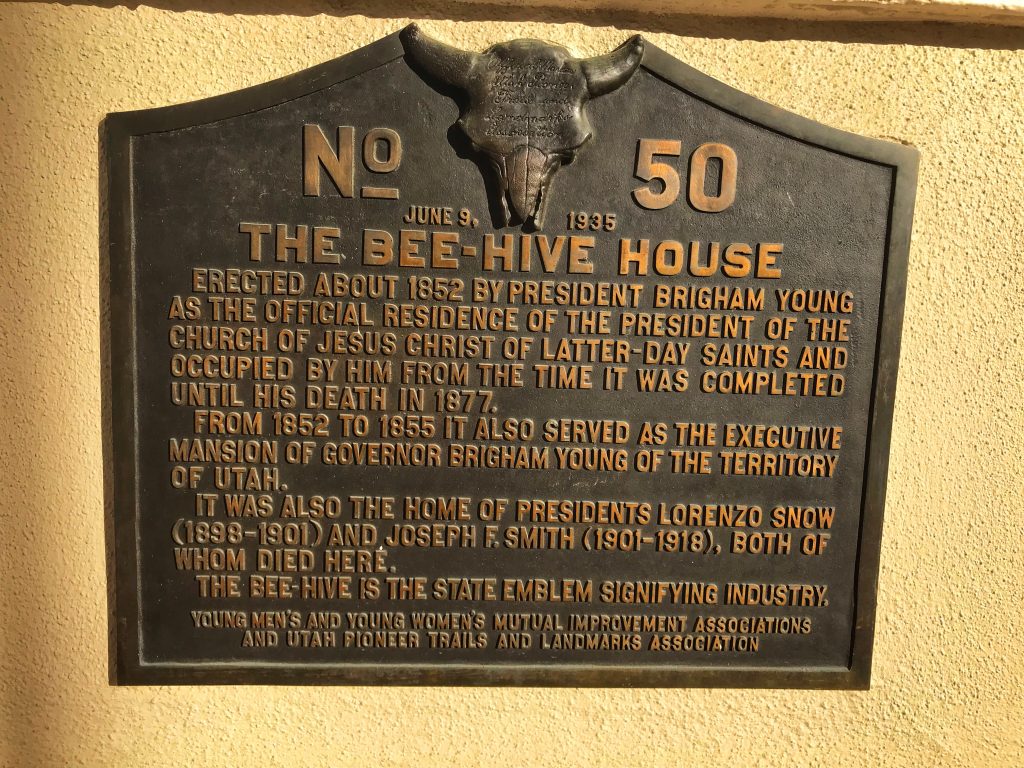
No 50 June 9, 1935 The Bee-Hive House Erected about 1852 by President Brigham Young as the official residence of the President of the Church of Jesus Christ of Latter-day Saints and occupied by him from the time it was completed until his death in 1877. From 1852 to 1855 it also served as the executive mansion of Governor Brigham Young of the Territory of Utah. It was also the home of Presidents Lorenzo Snow (1898-1901) and Joseph F. Smith (1901-1918), both of whom died here. The bee-hive is the state emblem signifying industry.

Extended Research:

The Beehive House was built in 1854 as the primary residence of Brigham Young as the first territorial governor of Utah and President of the Church of Jesus Christ of Latter-day Saints. It is located in the heart of downtown Salt Lake City at the intersection of State Street and South Temple (during the time of the home’s construction it was called Brigham Street).[1]  It is a two-story building with cement coating, large wrap-around porches, and topped with a large gilded beehive which inspired its official name: the Beehive House.[2]  

Figure 1: Beehive House and Eagle Gate (“Courtesy of the Church History Library, The Church of Jesus Christ of Latter-Day-Saints.”
Figure 2: Truman Osborn Angell (Courtesy of Temple Square Hospitality, The Church of Jesus Christ of Latter-Day-Saints.”)

The LDS architect of the Beehive House was Truman Osborn Angell. He was the LDS church’s resident architect and designed many of the prominent buildings in Utah Territory. His projects included but are not limited to the Salt Lake and St. George Temples; The Council House; the Social Hall; the Old Tabernacle; several meeting houses; the Utah Territorial Statehouse located in Fillmore; Brigham Young’s first grand residence, the White House; and the later addition to the Beehive house, the Lion House. Angell was a finish carpenter by trade and gained valuable experience working on various projects for The Church of Jesus Christ of Latter-day Saints, including the Kirtland and Nauvoo temples. He was called on a European mission and in addition to preaching the LDS gospel, Angell was assigned to study architecture. While Angell had close relationships with many church leaders throughout his life, the most influential was Brigham Young who married his sister Mary Ann. He enjoyed a close relationship with Brigham Young and looked up to him as a father figure.[3]

Figure 3: Interior Room of Beehive House by Michael McConkie, (Courtesy of the Church History Library, The Church of Jesus Christ of Latter-Day-Saints).

The primary function of the Beehive House was to serve as an official residence of Brigham Young in his role as both President of The Church of Jesus Christ of Latter-day Saints as well as the territorial governor.  It housed a small number of his family, out of town visitors, and provided a place to entertain visiting dignitaries and celebrities. Notable visitors included President Ulysses S. Grant, William T. Sherman, Ralph Waldo Emerson, Mark Twain, Horace Greely, and Tom Thumb.[4]

Figure 4: Brigham Young’s homes, Salt Lake City (Courtesy of the Church History Library, The Church of Jesus Christ of Latter-Day-Saints.)

Brigham Young had several residences in the Salt Lake Valley as well as throughout the Utah Territory. In 1856, two years after the Beehive House was complete, he constructed the Lion House that served as housing for several of his wives and children.[5] The Beehive House however, was home to second wife (nonplural at marriage), Mary Ann Angell.  She lived in the Beehive house on and off until 1860 when she moved into what was referred to as the White House (or Mansion House), a few blocks away.[6] She tended to enjoy a more secluded life and the hustle and bustle of the Beehive House did not suit her. Upon Mary Ann’s relocation, Lucy Decker, Brigham’s third wife moved in with her seven children and assumed the role of managing the home.  Near this time, Brigham deeded the Beehive House to Decker.[7] She lived there until she sold it to John W. Young, a son of Brigham and Mary Ann Young.[8]

Figure 5: Beehive House (Courtesy of the Church History Library, The Church of Jesus Christ of Latter-Day-Saints.)

Brigham Young wore many figurative hats. He was a business man, provider and patriarch to twenty-seven wives (although sealed to fifty-six, only twenty-seven were a part of his households) and fifty-seven children, politician and religious leader.[9] It was his style to be all of these at all times. It was common for Brigham Young to bring up secular matters in religious sermons and vice versa. He would preach to his children and discuss politics with various family members. His finances were similarly difficult to separate. Young trusted his bookkeeper to keep clear books, but his various accounts would borrow from one another.[10] This resulted in a level of uncertainty about who actually owned his various properties. For example, who was the owner of the Beehive House? Was it Brigham Young’s family home, an official state home, or was it church property where the president resided? The answer was that it was all of these. Since Brigham Young deeded it to Lucy Decker, it can be assumed he saw it as a personal family home. This issue however did cause some disagreements after Young’s death in 1877.

Figure 6: Beehive House and Eagle Gate with Cobblestone Wall (Courtesy of the Church History Library, The Church of Jesus Christ of Latter-Day-Saints.)

Living in the home was a communal experience. Despite the fact that the Beehive House served as the official residence of only a single family, it was also considered a home of last resort for newly arriving young people from Europe that had no family or friends to stay with. Young men were given jobs and young women, much to Lucy’s chagrin became students of the art of domesticity.[11] Nearly every morning Brigham Young would eat breakfast at the Beehive House with Lucy and her children. He would then go to the office located between the Lion and Beehive Houses. He would eat dinner with nearly fifty family members at the Lion House in the evenings followed by a family prayer. This tradition was faithfully observed regardless of what was on his agenda. He would frequently put meetings on hold and join his family.[12]

Figure 7: Deseret New Clipping January 20, 1893

During the time Brigham Young lived there, the Beehive House also served as a form of refuge and security from unfriendly forces. Several times when a flag was raised above the Beehive on top of the house, hundreds of men would come and surround the house to protect Brother Brigham. To further protect the residential compound, a nine-foot cobblestone wall was built. In addition to protecting his family, it provided work for the aforementioned young men arriving from abroad.[13]

In 1888, John W. Young purchased the property from Lucy Decker.  During the period of his ownership the home underwent major renovations and nearly doubled in size. In 1893, Young lost the home to pay off debts incurred in a lawsuit. The home was auctioned off and purchased by The Church of Jesus Christ of Latter-day Saints. It then served as the official residence of the President of the Church.[14] In 1900, LDS President Lorenzo Snow moved into the Beehive House and lived there until his death. His successor Joseph F. Smith lived there until is death in 1918.  Heber J. Grant, Smith’s successor, chose not to reside in the Beehive House. The home remained vacant for a couple of years and underwent some minor renovations.

Figure 8: David A. Smith on porch of Beehive House (Courtesy of the Church History Library, The Church of Jesus Christ of Latter-Day-Saints.)
Figure 9: President Joseph F. Smith in automobile in front of Beehive House (Courtesy of the Church History Library, The Church of Jesus Christ of Latter-Day-Saints.)

In 1920, following trends set in other cities, the Church decided to transform the Beehive House into a boarding home of sorts for women working or attending school in the city. Most young women living in the Beehive House either worked at the Church Office Building or attended LDS University. This use continued into the late 1950s. 

In 1959, the Church decided to restore the Beehive House to what it was like in its original form. A group was created, mostly comprised of Brigham Young’s descendants, to discover the original structure, assemble original furniture and furnishing and design a layout using a variety of written descriptions. In 1970, The Beehive House became a part of the National Register of Historic Places.  Since that time, it has been open to the public for tours.[15]


[1] Leonard J. Arrington, Brigham Young: American Moses. (Chicago, Illinois: University of Illinois Press, 1985), 169.

[2] Arrington, Brigham Young: American Moses, 170.

[3] Paul L. Anderson, “Truman O. Angell” Architect and Saint,” Supporting Saints: Life Stories of Nineteenth-Century Mormons (Provo, UT: Religious Studies Center, Brigham Young University, 1985), 133–73.

[4] Arrington, Brigham Young: American Moses, 329; National Register of Historic Places, Beehive House, Salt Lake County, Utah, National Register #702439002.

[5] R. Scott Lloyd, “Lecture at Church History Symposium discusses the Beehive House, the Lion House and the young women of the Church”, Deseret News, 10 March 2016.

[6] John G. Turner, Brigham Young: Pioneer Prophet. (Cambridge, Massachusetts and London, England: The Belknap Press of Harvard University Press, 2012), 236.

[7] Arrington, Brigham Young: American Moses, 329.

[8] Arrington, Brigham Young: American Moses, 329; John G. Turner, Brigham Young: Pioneer Prophet, 236.

[9] Arrington, Brigham Young: American Moses, 420-421; Jeffery Ogden Johnson, “Determining and Defining ‘Wife’: The Brigham Young Households,” Dialogue, A Journal of Mormon Thought 20 (Autumn 1987):57-70.

[10] Leonard J. Arrington and Ronald K. Esplin, “Building a Commonwealth: The Secular Leadership of Brigham Young,” Utah Historical Quarterly 45, no. 3 (1977): 216-232; Arrington, Brigham Young: American Moses, 178-182.

[11] Arrington, Brigham Young: American Moses, 330.

[12] Arrington, Brigham Young: American Moses, 329; John G. Turner, Brigham Young: Pioneer Prophet, 236.

[13] National Register of Historic Places, Beehive House, Salt Lake County, Utah, National Register #702439002; John G. Turner, Brigham Young: Pioneer Prophet, 298.

[14] National Register of Historic Places, Beehive House, Salt Lake County, Utah, National Register #702439002.; “The Beehive House Sold,” Deseret News, January 20, 1893.

[15] National Register of Historic Places, Beehive House, Salt Lake County, Utah, National Register #702439002; Lloyd, “Lecture at Church History Symposium”.

For Further Reference

Primary Sources

Photograph Citations:

Figure 1

F.I. Monsen and Company (Photography Studio). Beehive House and Eagle Gate.

Figure 2

Tammy Reque, “Interesting Facts You Didn’t Know About the Salt Lake Temple,” Temple Square Blog, July 20, 2018.

Figure 3

Lion and Beehive houses, 1983.

Figure 4

Brigham Young’s homes, Salt Lake City.

Figure 5

Horrocks, Samuel 1873-1927. Photographs of historical buildings in Salt Lake City, Utah.

Figure 6

“The Beehive House Sold,” Deseret News, January 20, 1893.

Figure 7

Charles W. Carter glass negative collection, circa 1860-1900; Items 121-135; Salt Lake City, Beehive House and Eagle Gate; Church History Library.

Figure 8

Beehive House, Salt Lake City, Utah, 1918 January 17.

Figure 9

Beehive House family photographs, circa 1896-1917; Beehive House Family Photographs; One of the first automobiles in Salt Lake City; Church History Library.

National Register of Historic Places, Beehive House, Salt Lake County, Utah, National Register #702439002. 

Secondary Sources

Anderson, Paul L. “Truman O. Angell” Architect and Saint,” Supporting Saints: Life Stories of Nineteenth-Century Mormons. Provo: Religious Studies Center, Brigham Young University, 1985.

Arrington, Leonard J., Brigham Young: American Moses. Chicago: University of Illinois Press, 1985.

Arrington, Leonard J.  and Ronald K. Esplin, “Building a Commonwealth: The Secular Leadership of Brigham Young”, Utah Historical Quarterly 45, no. 3 (1977): 216-232.

Johnson, Jeffery Ogden. “Determining and Defining ‘Wife’: The Brigham Young Households,” Dialogue, A Journal of Mormon Thought 20 (Autumn 1987):57-70.

Lloyd, R. Scott. “Lecture at Church History Symposium discusses the Beehive House, the Lion House and the young women of the Church”, Deseret News, 10 March 2016.

Turner, John G. Brigham Young: Pioneer Prophet. Cambridge: The Belknap Press of Harvard University Press, 2012.

Murray Smelting

Published / by Greg Murray / 1 Comment on Murray Smelting

Write-up by Gregory Murray 

Placed by: Murray Chapter of the Utah Sons of the Pioneers 

GPS Coordinates: 40°39’25” N 111°52’36” W 

Historical Marker Text: 

Gold, silver, copper, lead and zinc were found at Alta, Park City and Tintic in the years 1834 to 1869. Since no smelting was done in the state or the surrounding area, smelters had to be built. Billy Moran built the first smelter at 5189 South State Street on American Hill in 1869. The Woodhall Brothers built the first furnace on State Street by Big Cottonwood Creek June 1870. In 1871 the Germania Refinery & Wasatch Smelter were erected west of State Street on opposite sides of Little Cottonwood Creek. The Hanauer Smelter was built in 1872. The Horn Silver Smelter at 200 West 4800 South and the Highland Boy Plant 800 West Bullion came on stream 1880-1886. American Smelting and Refining Company took over the Germania Plant operations and later built a plant at 5200 South State St. which began operations in 1902. 

Smelting and ore refining grew from 0 tons to thousands of tons of ore per day. The need for smelting eventually decreased and in November 1950, the great smelting operation at Murray faded into History. Smelting in Murray had directly employed 10,000 people and indirectly thousands more, many of these people were pioneers who settled in the Murray community prior to the coming of the railroad. 

Extended Research: 

   The smelting industry developed in Murray, Utah, to extract metals from the ores produced by the mines of the Utah Territory. The arrival of the railroad in Utah greatly facilitated the development of smelting in Murray, which enabled miners to ship ore from mines such as Bingham Canyon and Camp Floyd to smelters in Murray. After the ore had been smelted into bars of metal, the smelters could ship the finished bars out on the transcontinental railroad. In the 1870’s and 1880’s, industrialists built several smelters in Murray, including the American Hill, Woodhull Brothers, Germania, Wasatch, Franklyn, and the Hanauer smelters.[1] Many of these smelters were very unprofitable in the early years. In a report to the federal government, U.S. Commissioner of Mining Rossiter W. Raymond, commented on the smelters in Murray, when he wrote, “fortunes were there lost in slags, dust, and matte.” However, technological improvements were soon able to increase the efficiency and profitability of the smelters.[2] American Smelting and Refining Company (ASARCO) bought many of Murray’s smelters as part of its efforts to consolidate the smelting industry in Murray.[3] ASARCO built its own smelter in Murray in 1902, which became the largest and most modern lead smelter in the State of Utah and became a major landmark in the city of Murray.[4] The ASARCO smelter could handle 1200 tons of ore per day through its eight blast furnaces and employed nearly one thousand five hundred people.[5]

    The ASARCO smelter attracted many immigrant workers from Southern and Eastern Europe to Murray. Many of these immigrant workers lived in slum-like dwellings near the railroads and around the smelter. Most of these homes lacked running water, and indoor toilets.[6] ASARCO tried to alleviate this housing problem in 1911 by building houses for some workers, and some Greek immigrants built boarding houses for the many workers employed at the smelters.[7] Smelter workers in Murray unionized in 1900 as part of the Western Federation of Miners and went on strike three times, in 1900, 1909, and 1912.[8] The 1912 strike in particular wracked the city with intense violence as some rogue strikers attempted to dynamite the smelter and assassinate one of the company supervisors.[9] These strikes generally failed to win the workers’ demands, and after the 1912 strike, the Murray local of the Western Federation of Miners disbanded.[10]

    The smelters also made an environmental impact on the valley. In the early twentieth century, critics of the smelters, mainly farmers, complained that pollution from the smelters was damaging their crops. In October 1904, farmers met in Murray to decide whether to take legal action against the smelters. One local farmer named George Gardner stated, “If we do not fight the smelters, they will impoverish us and kill us off. This valley will be desolated if the smelter smoke is not stopped. I believe we should go into court and fight them to the last ditch.”[11] The farmers won several court cases against the smelters which resulted in the closure of the Bingham Consolidated Smelter in 1907 and the Highland Boy smelter in 1908, but the ASARCO smelter was able to continue operations after paying a $60,000 fine. [12]

   From 1902 to 1931 the ASARCO smelter in Murray operated at near peak capacity, but as the Bingham, Park City, and Tintic mines began to run out of ore, the smelter in Murray declined. In 1931 the smelter shut down for seven months as a result of a shortage of ore. During the Great Depression, the smelter experienced many more temporary shutdowns. Production picked up during World War II, but in 1949, ASARCO announced the impending closure of the smelter, which was closed completely by November 1950.[13] The giant smokestacks of the smelter continued to stand in Murray for another half century. After voters rejected a $3.4 million bond to preserve the stacks in 1998, the city of Murray approved the demolition of the smokestacks of the smelter in August 2000.[14] The site of the old ASARCO smelter is now occupied by Intermountain Healthcare’s Intermountain Medical Center. 

[1] Brian P. Winterowd, “Murray Smelters,” in The History of Murray City, Utah, ed. Edna Mae Wilkinson (Murray, Utah: Murray City Corporation, 1976), 251-253.

[2] Thomas G. Alexander, “Generating Wealth from the Earth 1847-2000,” in From the Ground Up: The History of Mining in Utah, ed. Colleen Whitley (Logan, Utah: Utah State University Press, 2006), 41.

[3]  David L. Schirer, The Cultural Dynamics of Urbanization: Murray City, Utah, 1897-1919 (Salt Lake City, Utah: University of Utah, 1991), 81-84.

[4] Brian P. Winterowd, “Murray Smelters,” 254.

[5] Brian P. Winterowd, “Murray Smelters,” 255, 257.

[6] Brian P. Winterowd, “Murray Smelters,” 255.

[7] Brian P. Winterowd, “Murray Smelters,” 255.

David L. Schirer, The Cultural Dynamics of Urbanization, 203.

[8] David L. Schirer, The Cultural Dynamics of Urbanization, 91.

[9] “Bullets and Dynamiting in Murray Strike,” Salt Lake Tribune (Salt Lake City, UT), May 5, 1912.

[10] David L. Schirer, The Cultural Dynamics of Urbanization, 95.

[11]  “Farmers Will Fight Smelters,” Salt Lake Herald (Salt Lake City, UT), Oct. 21, 1904.

[12] David L. Schirer, The Cultural Dynamics of Urbanization, 67.

[13] Brian P. Winterowd, “Murray Smelters,” 257.

[14] Amy Joi Bryson, “Murray’s landmark smokestacks finally fall,” Deseret News (Salt Lake City, UT), Aug. 6, 2000.

 For Further Reference: 

Primary Sources: 

“Bullets and Dynamiting in Murray Strike.” Salt Lake Tribune (Salt Lake City, UT), May 5, 1912. 

Bryson, Amy Joi, “Murray’s landmark smokestacks finally fall.” Deseret News (Salt Lake City, UT), Aug., 2000. 

“Farmers Will Fight Smelters.” Salt Lake Herald (Salt Lake City, UT), Oct. 21, 1904. 

Secondary Sources: 

Schirer, David L. The Cultural Dynamics of Urbanization: Murray City, Utah, 1897-1919. Salt Lake City, Utah: University of Utah, 1991. 

Alexander, Thomas G. “Generating Wealth from the Earth 1847-2000.” In From the Ground Up: The History of Mining in Utah, edited by Colleen Whitley, 37-57. Logan, Utah: Utah State University Press, 2006.

Winterowd, Brian P. “Murray Smelters.” in The History of Murray City, Utah, ed. Edna Mae Wilkinson. Murray, Utah: Murray City Corporation, 1976. 

Trinity African Methodist Episcopal Church

Published / by Martha Hernandez / 2 Comments on Trinity African Methodist Episcopal Church

Write up by Martha Hernandez

Placed by: Utah State Historical Society

GPS Coordinates: N 40° 45.390 W 111° 53.025

Historical Marker Text: Organized during the 1880’s by the Reverend T. Saunders, this congregation has served as a focus of Black religious, social, and cultural activity in Utah from territorial days to the present. In 1907 property at this spot was acquired, and a church designed by Hurly Howell was constructed through the sacrifice and energy of the congregation under the Revered T.C. Bell. Restoration was begun in 1976 under the Reverend D.D. Wilson.

Extended Research:
The beginnings of the African Methodist Episcopal church of Salt Lake City can be traced back to an organizational meeting led by Reverend James Saunders on November 1890.[1] Although initially located on Fourth West and Sixth South, the African Methodist Episcopal church switched locations several times between 1890 and 1910. Additional changes took place under the leadership of Reverend McIntyre, including a name change. The A.M.E. Church became the Trinity African Methodist Episcopal church.[2]

Finally, in 1907, after years of holding church meetings in private homes, the congregation of the Trinity African Methodist Episcopal Church fundraised and purchased the land property where the Trinity A.M.E. still stands today. Construction of the church building began in 1909 and restoration took place under Reverend D.D. Wilson in 1976.

The Trinity A.M.E. Church is located at 239 East Martin Luther King Boulevard (600 South) in Salt Lake City, Utah. The Trinity A.M.E. has Gothic revival architecture. The building is small and rectangular with a square tower, stained-glass windows, wooden doors, and a red brick exterior.

In addition to providing religious services, the Trinity A.M.E. played a critical role in the development of community for African Americans in Salt Lake City between 1890 and 1910. Shortly after the founding of the Trinity A.M.E., the African American community in Salt Lake City founded fraternal orders, civic and social clubs, and a women’s club.[3] The small population size of the African American community in Salt Lake City, along with racial prejudice against African Americans at the national level between 1847 and 1910 created the need for spaces where African Americans could worship, congregate, socialize, and support each other.[4] African American churches like Trinity A.M.E. served the spiritual and secular needs of their members.

In 2012 the Trinity A.M.E. Church suffered water damage to its basement walls, which caused attendance to dwindle to about 50 worshipers per week.[5] As of 2017, the Trinity A.M.E. church is a living landmark and continues to serve its congregation by holding religious services including Sunday morning worship, church school, bible study, and special events like film screenings.[6]


[1] Miriam B. Murphy, “African Americans Built Churches.” Utah Historical Quarterly.

[2] Ronald G. Coleman, “A History of Blacks in Utah, 1825-1910”. (PhD dissertation, University of Utah, 1980), 90-91.

[3] Ronald G. Coleman, “African American Community and Politics, 1890-1910,” Utah Historical Quarterly.

[4] George M. Fredrickson, The Black Image in the White Mind: The Debate on Afro-American Character and Destiny, 1817-1914, (New York: Harper & Row, 1971).

[5] Donald W. Myers, “Faiths Rally to Restore Historic Salt Lake City Church”. The Salt Lake Tribune. February 16, 2012.

[6] Kristen Moulton, “Salt Lake City Church Screens Raw but Redemptive ‘Precious’”. The Salt Lake Tribune. July 2, 2010.

For Further Reference:

Primary Sources:

Moulton, Kristen. “Salt Lake City Church Screens Raw but Redemptive ‘Precious’”. The Salt Lake Tribune. July 2, 2010. http://archive.sltrib.com/article.php?id=9972498&itype=storyID

Myers W. Donald. “Faiths Rally to Restore Historic Salt Lake City Church”. The Salt Lake Tribune. February 16, 2012. http://archive.sltrib.com/story.php?ref=/sltrib/news/53513844-78/church-bachman-ame-utah.html.csp

Secondary Sources:

Coleman G. Ronald. “A History of Blacks in Utah, 1825-1910”. (PhD dissertation, University of Utah, 1980), 90-91.

Coleman G. Ronald. “African American Community and Politics, 1890-1910.” Utah Historical Quarterly. https://heritage.utah.gov/tag/trinity-african-methodist-episcopal-church

Fredrickson M. George. The Black Image in the White Mind: The Debate on Afro-American Character and Destiny, 1817-1914, (New York: Harper & Row, 1971).

Murphy B. Miriam. “African Americans Built Churches.” Utah Historical Quarterly. https://heritage.utah.gov/history/uhg-african-americans-built-churches

1853 Holladay Fort

Published / by Ben Hopes / Leave a Comment

By Ben Hopes, Masters of Education Graduate Student

GPS Coordinates: 40˚ 37’ 4.84” N, 111˚ 49’ 36.21”

Holladay Historical Marker

Extended Research About Holladay:

In July of 1847, Holladay became the first village established independent of Salt Lake City. At the time, Latter Day Saints Prophet Brigham Young sent out members of his congregation to colonize different parts of Utah, particularly areas rich in natural resources. Led by John Brown, the pioneers of the Mississippi Company founded the village, flourishing with an abundance of natural resources. A free flowing stream fed through the Holladay area, and provided the rich and fertile lands for farming and planting[1]. The area was known as Cottonwood or the Mississippi Ward, but would be named Holladay after a particularly influential bishop, John D. Holladay. The settlement would grow to include schools, churches, and the creation of a fort in 1853, intended as protection against Native American raids but instead became a place for the settlers to gather.

Marker at Approximate Location of Southeast Corner of Holladay Fort

The Mississippi Company itself had known hardship; they had existed in the Southern States Mission, where they were often met with vitriol and physical harm[2]. They had moved west nearly a full year before the Mormon exodus of 1847, wintering at Pueblo, Colorado. Many of its members volunteered to join the Mormon Battalion, formed to aid the United States’ incursion into Mexico: The men and their families knew sacrifice. The struggles that they encountered in trying to fulfill their Prophet’s, and ultimately their God’s, vision created in them a firm belief that they were truly a chosen people destined for eternal greatness. According to various accounts, the Saints of this era met each challenge with the strength of their convictions and the willingness to work together, united in their goals[3]. Pioneers saw obstacles, such as hunger or physical hardship on the trail, as trials to be conquered with the aid of an almighty God. The Mississippi Company acted admirably in much the same way.

The Mormon colonization efforts were remarkable. Because of their strong, central leadership and the complete cooperation of their congregations, a community infrastructure could be quickly established that led to economically competent planning, ensuring a town’s immediate survival. One can see the precision of the Mormon colonization machine in the fact that Holladay was founded only a month after the Brigham Young’s famous incursion into the Salt Lake Valley. The tenacity of their efforts would further be reflected in the founding of the San Bernadino Mission in California (1851) by some of the members of the Mississippi Company.

Six years after the Mormon migration of 1847, Chief Walker of the Ute tribe declared war on the Mormons in the valley, in immediate retaliation for the death of a Ute Indian in a small conflict in Utah Valley, and for the larger reason that the Mormon people had encroached on his tribe’s lands and did not seem to have any intention of letting up in their colonization efforts. While this is called the Walker War, there was not much conflict: it was mainly a series of Indian raids and small Mormon reprisals. There were no great battles and a peace would be declared in May of 1854, with few conciliatory negotiations to resolve the ideological conflicts between the two groups.[4]

About the Holladay Fort:

However, the fear of Indian attacks led to the creation of the Holladay Fort in 1853 (it is very likely that it was never completely finished). Built from adobe mud and straw, it provided some protection but the Indian threat (the attacks were focused mainly in central Utah) was not enough to convince Holladay’s 161 inhabitants to move in. A house within its walls would serve as the meeting place for school and church functions in the area, until a new school/church would be built on the fort grounds in 1861.

In 1873, a new church, separate from the school, was built on the grounds. This church would serve LDS needs until 1972. In 1876, a new school was constructed on the fort site, accommodating school children until 1893, when another school was constructed just south. This 2-story, 4-room school would become a gymnasium for the 3-story, newly renamed Irving Junior High School, created in 1905. Irving Junior High was built to the west of the 1893 building (the gymnasium) and would be renamed Olympus Junior High in 1943.

Approximate Location of the 1853 Holladay Fort (Now a Field for Olympus Junior High)

Olympus Junior High would be torn down in 2002 to make way for a new school, moved slightly to the west of the original site. Today the grounds of the fort roughly encompass the entirety of the field used by the school, in addition to a small business and the LDS seminary building that Olympus Junior students regularly attend. Despite resistance to the westward move[5], the new building has become a community landmark and important facet of family life in Holladay itself.

The creation of the Holladay Fort in 1853, while not initially significant, set aside an area that would become culturally and socially important to the community for nearly the next 100 years. Out of regional fears, the fort was designed to keep raiding Utes out and yet it proved to be a joyful place where the community gathered to celebrate their own culture and to continually devote themselves to their religion. By housing the educational and spiritual centers of Holladay, the fort provided the means for Mormon culture to survive and grow, fed by Spring Creek in the shadow of Mount Olympus.

Marker Placed by: The City of Holladay, Jay M. Todd (constructed in July 1996), surveyed by Kate Wacker (Utah State Historical Society)

 Secondary Sources:

  • Arrington, Leonard J. “The Mississippi Mormons.” Ensign June 1977: N.p. Web. 29 Mar. 2017
  • Bigler, David L., and Bagley, Will.Army of Israel: Mormon Battalion Narratives. 2000. Print. Kingdom in the West ; v. 4.
  • Christy, Howard A.The Walker War: Defense and Conciliation as Strategy.  Print.
  • Parrish, William E. “The Mississippi Saints.”Historian 4 (1988): 489-506.
  • Van Leer, Twila. “School Construction Gets F From Residents.” Deseret News, 23 Aug. 2002. Web. 30 Mar. 2017.
  • “City of Holladay.” City of Holladay. N.p., 2016. Web. 29 Mar. 2017. http://cityofholladay.com/community/about/history/

Primary Sources:

  • Bullock, Thomas.The Pioneer Camp of the Saints: The 1846 and 1847 Mormon Trail Journals of Thomas Bullock. Vol. 1. Arthur H Clark, 1997. Print.
  • Olsen, Alice M., Olsen, R. L, and Lewis, Ira Allen. Mount Olympus & Holladay, Early Years (1920-30) : Featuring the Photographic Art Taken 1920-1930+ by Ira Allen Lewis (b. 1877 Holladay, Utah-d. 1948 Holladay, Utah), Some of the Old Homes of Holladay, Mount Olympus, Cottonwood Creek & Holladay (photographed from 1940-2010 by Alice McDonald Olsen). Print.

[1] “City of Holladay.” City of Holladay. N.p., 2016. Web. 29 Mar. 2017.

[2] Arrington, Leonard J. “The Mississippi Mormons.” Ensign June 1977: N.p. Web. 29 Mar. 2017

[3] Bullock, Thomas. The Pioneer Camp of the Saints: The 1846 and 1847 Mormon Trail Journals of Thomas Bullock. Vol. 1. Arthur H Clark, 1997.

[4] Christy, Howard A. The Walker War : Defense and Conciliation as Strategy. 1979. Web. 30 Mar. 2017.

[5] Van Leer, Twila. “School Construction Gets F From Residents.” Deseret News, 23 Aug. 2002. Web. 30 Mar. 2017.

German War Memorial

Published / by Kaleigh McLaughlin / 1 Comment on German War Memorial

Write-up by Kaleigh McLaughlin Undergraduate B.A. History and International Studies, University of Utah, University of South Dakota


Coordinates:  40.7601° N, 111.8243° W


Transcript:

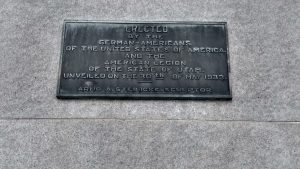
Erected by the German-Americans of the United States of America. And the American Legion of the State of Utah. Unveiled on the 30th of May 1933.

Arno A. Steinicke. Sculptor


Transcript:

German War Memorial

The German War Memorial to the Victims of War was erected by the German-Americans of the United States of America in cooperation with the American Legion of the State of Utah in memory of the men who died while interred at Fort Douglas during World War I.

The monument was designed and constructed by Arno Steinicke. It was dedicated on Memorial Day, May 30, 1933.

Fifty-five years later, in 1988, the monument was restored by sculptor Hans Huettlinger and his son John under arrangements made by the German Air Force and German War Graves Commission.

Today the restored monument stands in of the victims of both World Wars who are buried here in Fort Douglas Cemetery and to the victims of war and despotism throughout the world.

Transcript Right Column in German:

Das  Deutsche Ehrenmal der Kriegstoten wurde von den Deutsch-Amerikanern in Zusammenarbeit mit der American Legion of the State of Utah zum Gedenken an die als Internierte und Kriegsgefangene des I. Weltkrieges in Fort Douglas verstorbenen Deutsch errichtet.

Kunstlerischer Entwurt und Ausfuhrung der Arbeiten erfolgeten durch Arno A. Steinecke. Das Ehrenmal wurde am Memorial Day, den 30. Mai 1933 eigeweiht.

Nach 55 Jahren wurde das Ehrenmal 1988 auf Initiative der Deutsch Luftwaffe im Zusammenwirken mit dem Volksbund Deutsche Kriegsgraberfursorge e.V. durch den Bildhauer Has Huttlinger und seinen Sohn John aus Salt Lake City restauriert.

Das Ehrenmal dient nun dem Gedenken der Opfer der beiden Weltkriege, die hier in Fort Douglas ruhen sowie darbuer hinaus allen Opfern von Kriegen und Gewaltherrschaft in der Welt.

 Transcript:

The Last Resting Place of 21 German Prisoners of War who died at Fort Douglas during the World War

1917-1918

Henry L. Zinnel

Frank Stadler

Arthur Ruebe

Karl G. W. Blaase

Erich Laevemann

Friedrich O. Hanf

Walter J. Piezareck

Emil Laschke

Roko Zilko

Felix Behr

Maximilian Kampmann

Max Leopold

Joseph Fuckola

Herman Lieder

Stanislaus Lewitski

Georg Schmidt

Charles Morth

Frank Benes

Adolf Wachenhusen

Herman German

Walter Topff


Extended Research

On April 6, 1917 the United States unilaterally declared war on Germany. This moment marked the beginning of U.S. entry into the First World War. Accompanying U.S. entry into the war were all of the complications including the logistical, and tactical issues associated with war. One such issue the U.S. had to face was the treatment of ‘enemy aliens’. “Enemy aliens were defined as males born in Germany over the age of fourteen who have not been naturalized[1]”. As U.S. involvement in WWI progressed the ‘enemy alien’ classification was broadened to include Austro-Hungarians as well.

German Consul and Memorial Designer Steinicke Visiting the Memorial. Salt Lake Telegram, May 29, 1937


A person classified as ‘enemy alien’ was restricted in their freedom of speech and their mobility. Specifically, “enemy aliens were not allowed to write, print, or publish any attack against the United States or against anyone in the civil service, armed forces or the local municipal government[2]” Furthermore, “no alien enemy could depart the United States without a permit except under court order[3]”.  Under section 4067 of the Revised Statutes of the United States, enemy aliens who violated, or were suspected of violating these prohibitions were subject to arrest, internment, and removal.

Fort Douglas, Utah was to be the site of one of three designated camps during WWI.  “On May 2, 1917 [a] public announcement was made that Fort Douglas was to be the site of one of three internment camps for German prisoners of war taken from naval vessels[4]”. However, as U.S. involvement in the Great War continued, hysteria and paranoia about German spy plots increased. This occurred alongside a rise in arrests of enemy aliens for suspected subversive activities by U.S. Marshals. As a result, the designation of Fort Douglas changed. Originally, the camp was to contain German naval prisoners of war, however, this designation changed to include both naval prisoners of war, and enemy aliens.  In March of 1918, all of the remaining naval sailors were moved to Fort McPherson in Georgia and the camp at Fort Douglas evolved into an internment camp for enemy aliens[5]. This change has particular significance for the German War Memorial at the at the Fort Douglas cemetery. Out of the 21 names listed on the German War Memorial, only one is a naval prisoner of war (Stanilaus Lewitski), the rest are enemy aliens.

Salt Lake Telegram, May 30, 1935

Fort Douglas was “chosen for its central locality and its proximity to a main rail line[6]” The proximity to the railroad is the critical selection criteria, because the railroad would easily facilitate the transportation of interned aliens and prisoners of war. The ease of transportation was crucial to the selection of Fort Douglas because of the locations of the two other internment camps.  “The other two camps were located at Fort McPherson and Fort Oglethorpe in Georgia[7]”.  This meant that Fort Douglas was the only location west of the Mississippi where prisoners of war and interned aliens could be detained. “The civilian enemy aliens were rounded up by local authorities in most western states including Texas, California, Arizona, Washington, Oregon, Nebraska, and South Dakota[8]” and then interned at Fort Douglas.

Life at Fort Douglas was different depending on whether you were a prisoner of war or an enemy alien. From the outset German prisoners of war were physically separated from the interned enemy aliens. This was an intentional action as specified by a letter to the inspector general of the army stating that there must be an that there must be an “absolute separation of Prisoners of War from interned aliens by sending the former class to the War Prison Barracks, at Fort McPherson, Georgia”.  The two groups at Fort Douglas enjoyed different privileges and experienced vastly different treatment throughout their stay at the camp. Inspections of the War Prison Barracks by the Swiss Legation demonstrate the differences between the two camps. In 1917, the barrack inspection of the prisoner of war camp “found it [the camp] in all respects excellent. The only problem was the athletic field. It was found to be too small[9]”. However, with regard to the inspection of the enemy alien camp the Swiss Legation concluded: “To attend church services, civilians [enemy aliens] had to make a request. Civilians were not allowed to partake in activities in the Y.M.C.A…persons suffering from Syphilis were not separated from other prisoners[10]”. Furthermore, there was a note about the increasing antagonism and animosity between the guards and the enemy aliens.

The experiences of Stanislaus Lewitski (a war prisoner) and Heinrich Ludwig (Henry L) Zinnel (enemy alien), underscore the differences between the two groups at Fort Douglas.

“An illiterate machinist employed at the Southwestern Machine Shop in El Paso, was working the day of his arrest. Heinrich Ludwig Zinnel, a thirty-five-year-old native of Germany, was making $4.50 per day when, on December 17, 1917, he was arrested and taken to the county jail at El Paso…Zinnel’s property was confiscated upon arrest and he remained at the country jail until eight days later when he was taken to Fort Douglas, on Christmas Day[11]”.

Cunningham continues Zinnel’s story noting that Zinnel accidentally injured himself while on the way to Fort Douglas. Visits to doctors proved to be ineffective, with one doctor accusing Zinnel of faking his illness. However, upon arrival at Fort Douglas Zinnel was desperately ill. He was suffering from fevers and losing weight. A roommate of Zinnel at Fort Douglas noted that Zinnel went from being about 180 pounds to 90. The doctor who attended Zinnel believed he was suffering from acute gastritis from some sort of poisoning. On June 1, 1918 Zinnel died. “A death certificate was not filed with the State of Utah, which was required by state law, and as a posthumous insult, his body was taken to be buried In the Fort Douglas Cemetery in a garbage wagon[12]”.      
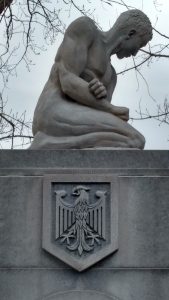
It is significant to contrast the treatment of Zinnel with that of another detainee at Fort Douglas. Stanislaus Lewitski, was one of the prisoners of war. Lewitski was a member of the SMS Cormoron, a ship which was captured and destroyed near Guam. Lewitski sustained a fatal injury while doing some gymnastics at the Y.M.C.A. Lewitski suffered from a broken spinal column and died within a few days of receiving his injuries. While both Zinnel and Lewitski may have died at Fort Douglas their treatment after death is where those similarities end. In contrast to Zinnel, Lewitski was taken and “buried in the Fort Douglas Cemetery with full honors[13]”. The comparison in treatment after death between Zinnel and Lewitski underscores the differences between prisoners of war and enemy aliens at Fort Douglas. Another experience highlighting this difference was that of Emil Laschke. He “was an interned alien, but was a naval officer by trade. Hentschel [another inmate] recalled, ‘one of the dead, a Junior Officer in the Navy, Emil Laschke, was mocked by the placing of a gray cross upon his body and he was refused a grave stone[14]’”.

The differences in treatment between the war prisoners and enemy aliens, offer insights into the perceptions of Americans of the time about these groups. The Naval prisoners held at Fort Douglas were legitimate combatant actors in war. These were patriotic men fighting for their nation. In this regard, they were very similar to their American counterparts. However, enemy aliens were perceived differently. The classification of these people  ‘enemy aliens’ has strong and significant connotations, which could have helped to shape perceptions of Americans about such people. The plethora of propaganda and paranoia towards enemy aliens clearly illustrates what the perceptions of Americans were towards this group. Enemy aliens were perceived as dishonorable combatants. They were spies and defectors of malicious intent who embedded themselves among the general populace seeking subterfuge. They were a strange people who had refused assimilation into American life, and who had more importantly, refused American citizenship. All of these factors combined helped to make enemy aliens especially suspect during the war years.

However, it is important to note that enemy aliens were civilian noncombatants living in the United States. Many were immigrants who became trapped behind enemy lines with the declaration of war. Often, enemy aliens, were people negatively affected by wartime policy through no fault of their own. Many of the enemy aliens, due to vague laws, rumors, and suspicion were persecuted, arrested, and interned with little to no recourse. The true tragedy of camps like Fort Douglas is evidenced by the lives of those who lived and died within such camps. Interment, meant the loss of jobs, social isolation and stigmatization, and could also mean death. In the case of Fort Douglas, each of the 21 men interned were people with the agency to succeed and flourish within the United States. It is a somber truth that the internment of these men resulted in their deaths denying them such opportunities. But, it is this somber truth which demonstrates the need for historical research to serve as documentation, but more importantly as a remembrance for those who lived and died at the Fort Douglas internment camp during World War I. What follows are short biographical sketches of the men whose names are listed on the historical marker at the Fort Douglas cemetery. The majority of the men died of illness related to the global Spanish Influenza outbreak that killed forty million people worldwide: during World War I.

Arthur Ruebe                                                                                                                                

According to his death certificate, Arthur Ruebe was interned alien enemy no. 1150. He was a merchant born in Erfurst, Thueringis, Germany. His mother and father are unknown, however, he was married and therefore survived by a wife.
Ruebe died on December 22, 1918, at the age of 44, the cause of death was identified as Bronchio-pneumonia following influenza. The afflicting illness lasted 19 days. Rube was attended to by the leading doctor of War Prison Barracks Three, William F. Beer. He was buried at the Fort Douglas Cemetery on December 23.

Charles Morth

According to his death certificate, Charles Morth was interned alien enemy no. 1054. He was born in Krukenberg, Germany. His mother and father are unknown. Morth was married and survived by a wife. Morth died on December 1, 1918 at age 50 from pneumonia, a condition which affected him for two days. Influenza is listed as a contributory affliction. Morth was also attended by Dr. Beer. He was buried at Fort Douglas Cemetery, December 2, 1918. The Salt Lake Tribune published notice of  Morth’s death.

Emil Laschke

The death certificate of Emil Laschke lists him as German Prisoner of War no. 773. Laschke was a machinist mate from Breslau, Silesia, Germany. His father was Heinrich Laschke, his mother is unknown. At his time of death he was unmarried. Laschke died on December 3, 1918 at the age of 25 from influenza. Bronchial pneumonia is listed as a contributory affliction. The cause of death and afflicting conditions lasted 9 days. Laschke was attended by Dr. Beer and was buried in the Fort Douglas Cemetery on December 4, 1918. On December 5, 1918 the Salt Lake Telegram documented Laschke’s death.

Erich Laevemann                                                                  

Erich Laevemann is listed as Prisoner of War no. 813. He was born in Duisburg on the Rhine, Germany. His mother and father are listed as unknown. At the time of his death he was unmarried. Laevemann died on December 10, 1918, at age 22 of bronchial pneumonia. A contributory affliction is listed as influenza. The primary and contributory illnesses lasted 6 days. Attended to by Dr. Beer, Laevemann was buried in the Fort Douglas Cemetery on December 12, 1918. No newspaper sources have been discovered documenting the death of Laevemann.

Felix Behr

According to his death certificate, Felix Behr is listed as interned enemy alien no. 1151. Behr was born in Stotzheim, Alsace. His occupation is listed as a jeweler. His parents are unknown and at his time of death he was unmarried. Behr died on November 29, 1918 at the age of 32 from influenza complicated by pneumonia. His influenza lasted for seven days, and the pneumonia developed on the third  day.  At his time of death Behr had lived at Fort Douglas for three months and two days. He was attended by Dr. Beer and was buried in the Fort Douglas Cemetery on November 30, 1918. The Deseret News and Ogden Standard reported Behr’s death shortly thereafter.

Frank Benes

Frank Benes is listed as interned alien enemy no. 914. He was born in Germany in 1894. His parents are unknown. He worked as a miner and at the time of his death he was unmarried. Benes died on November 6, 1918 at age 24 from pneumonia, lobar, bi-lateral. At his time of death, Benes had resided at Fort Douglas for one month and eight days. He was attended by Dr. Beer and was buried in the Fort Douglas Cemetery on November 7, 1918. The Deseret News and Salt Lake Tribune reported Benes death shortly thereafter.

Herman Lieder

Herman Lieder is listed as interned alien enemy no. 889. He was born in Gera, Turingen, Germany to Paul and Lina Lieder on January 24, 1894. Lieder was a coppersmith and at the time of his death was unmarried. Lieder died on November 18, 1918 at age 24 from pneumonia, pyogenic, bi-lateral, lobar lasting three days. A contributory affliction is listed as a severe cold which lasted one day. At his time of death, Lieder had resided at Fort Douglas for seven months. He was attended by Dr. Beer and was buried in Fort Douglas Cemetery on November 19, 1918.  On November 20, 1918 the Salt Lake Tribune reported Lieder’s death.

Joseph (Joe) Fuckala

According to his death certificate, Joseph Fuckala is listed as interned alien enemy no. 738. He was born in Zelo-Orda, Croatia to Latzko Fukala and Anna Sullitsch. Fuckala was a carpenter and at the time of his death he was unmarried.  Fuckala died on November 23, 1918, at age 30 of Spanish influenza complicated with pneumonia hemorrhages. The affliction lasted three days. At his time of death, Fuckala had resided at Fort Douglas for seven months and twenty-five days. He was attended by Dr. Beer and was buried in the Fort Douglas Cemetery on November 24, 1918.

Max Leopold

According to his death certificate, Max Leopold is listed as interned alien enemy no. 584. Leopold was born in Germany, his parents are unknown. Leopold’s occupation is unknown. At his time of death he was unmarried. Leopold died on November 24, 1918 age 32 of pneumonia hemorrhages bi-lateral lasting one and-a-half days. A contributory affliction, Spanish influenza is listed as lasting three days. At the time of his death, Fuckala had resided at Fort Douglas for one year three months and twenty-four days. He was attended by Dr. Beer and was buried in Fort Douglas Cemetery on November 25, 1918. No newspaper sources were found to report on Leopold’s death.

Maximilian Kampmann

Maximilian Kampmann is listed as interned alien enemy no. 597. Kampmann was born in Elberfeld, Germany, his parents are unknown. Kampmann was a well-respected doctor, specifically a psycho-pathologist who had lived and worked in the Utah area since 1916. Kampmann died on November 26, 1918 at age 29 of pneumonia lasting three days and influenza lasting six days. At the time of his death Kampmann resided at Fort Douglas for one year two months and twenty-six days. Kampmann had at some point formerly resided in Sper Lake, Los Angeles. Kampmann was attended by Dr. Beer and was buried in the Fort Douglas Cemetery on November 28, 1918. The Ogden Standard, the Sun, the Salt Lake Tribune, and Salt Lake Telegram all reported on Kampmann between the period of 1916-1918.

Roko Zilko

The death certificate for Roko Zilko does not specify an interned alien enemy status. However, Zilko was born on the Island of Vys Dalmatia. Zilko’s occupation is listed as a laborer. His parents are unknown. At the time of his death he was unmarried. Zilko died of pneumonia at age 36 on November 30, 1918. The pneumonia developed on the fourth day while he was suffering from influenza for seven days.  At his time of death Zilko had resided at Fort Douglas for one month and twenty-nine days. A former residence is listed as possibly Austria (the word Austria is accompanied by a question mark). Zilko was attended by Dr. Beer and was buried in the Fort Douglas Cemetery on December 1, 1918. No newspaper sources were found to report on the death.

Stanilaus Lewitzki

In a similar situation as Zilko, the death certificate of Stanilaus Lewitzki does not list a prisoner of war number. However, Lewitzki was born in Germany. His parents are unknown and at the time of his death he was unmarried. Lewitzki was a sailor serving on the SMS Cormoron. Lewitzki died on September 13, 1917 at the age of 25 from a fractured spinal column with specific damage to the sixth cervical vertebrae. This injury was sustained while partaking in gymnastic activities at the prison camp. Lewitzki was admitted to the War Barracks Hospital on August 17, 1917. Lewitzki was attended by Dr. H. May and at the time of his death he had resided at Fort Douglas for one month and eleven days. Lewitzki was buried at Fort Douglas on September 14, 1917. The Salt Lake Telegram reported his death shortly thereafter.
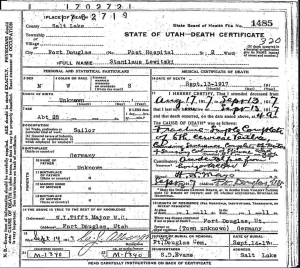
Walter J Piezareck

Walter J Piezareck is listed as interned alien enemy no. 862. He was born in Postdam, Germany. His parents are unknown and at his time of death Piezareck was unmarried. His occupation is listed as a laborer. Piezareck died on December 6, 1918 at the age of 31 from bronchial pneumonia. Influenza contributed to his death; both afflictions lasted nine days. Piezareck was attended by Dr. Beer and was buried in the Fort Douglas Cemetery on December 6, 1918. No newspaper sources were discovered to report his death.

Walter Toppf

Walter Toppf is listed as interned alien enemy no. 867. Toppf was born in Germnay to Louise Toppf. The birthplace of Louise Toppf is listed as W. Plumental St. Berlin, Germany. At his time of death his father and marital status were unknown. Toppf was an artist, specifically he was a painter. Toppf died on May 16, 1919 at the age of 33, from hemorrhage and the contributory affliction is listed as pulmonary lobar complications, both of which lasted for one month and twenty-four days. At his time of death, Toppf had resided at Fort Douglas for ten months and eight days. Toppf was attended by Dr. Beer and was buried on May 16, 1919. On May 17, 1919 the Salt Lake Tribune reported Toppf’s death.

Zinnel, Stadler, Blaase, Hanf, Schmidt, Wachenhusen, and German           

The aforementioned enemy aliens had no death certificates filed with the State of Utah. As such, there is extremely limited information on the lives of these men. Henirich Ludwig Zinnel, as previously mentioned was from El Paso. He died on June 1, 1918 from acute gastritis. He was known to be a laborer. Frank Stadler was an interned enemy alien who lived and died at Fort Douglas; any further information in unknown. Karl Johann W. Blaase was an interned enemy alien who lived and died at Fort Douglas. A ledger of interned enemy aliens revealed that Blaase was arrested on May 24, 1918, and he was sentenced to interment on July 5, 1918. According to historian Raymond Cunningham, Friedrich Otto Hanf:

“was one of those brought to Fort Douglas after the War, and was despondent over being there. As Christmas 1919 approached, Hanf was more depressed than usual. Fellow prisoners noticed that he was regretting the arrival of Christmas. At 7:30 a.m., Christmas morning, Hanf’s body was found hanging by a bedsheet from a rafter in his barracks[15]”.

The ledger of interned aliens at Fort Douglas also reveals that Hanf was arrested on December 7, 1919, and sentenced to internment on December 23, 1919.

Georg Schmidt and Adolf Wachenhusen were interned enemy aliens who lived and died at Fort Douglas with no further information known about their identities. Herman German was an interned enemy alien who lived and died at Fort Douglas. It is unlikely that Herman’s last name was German. It is more likely that his last name was unknown and he was known as ‘Herman the German,’ however, any further information is unknown.

Sources:

Primary

Beer, William F. Arthur Rube Death Certificate. Utah State Archives. December 23, 1918.

Beer, William F. Charles Morth Death Certificate. Utah State Archives. December 3, 1918.

Beer, Willian F. Emil Laschke Death Certificate. Utah State Archives. December 4, 1918.

Beer, William F. Erich Laevemann Death Certificate. Utah State Archives. December 11, 1918.

Beer, William F. Felix Behr Death Certificate. Utah State Archives. November 30, 1918.

Beer, William F. Frank Benes Death Certificate. Utah State Archives. November 7, 1918.

Beer, William F. Herman Lieder Death Certificate. Utah State Archives. November 18, 1918.

Beer, William F. Joseph Fuckala Death Certificate. Utah State Archives. November 24, 1918.

Beer, William F. Max Leopold Death Certificate. Utah State Archives. November 24, 1918.

Beer, William F. Maximilian Kampmann Death Certificate. Utah State Archives. November 28, 1918.

Beer, William F. Roko Zilko Death Certificate. Utah State Archives. November 30, 1918.

May, H. Stanilaus Lewitzki Death Certificate. Utah State Archives. September 13, 1917.

Beer, William F. Walter J Piezareck Death Certificate. Utah State Archives. December 6, 1918.

Beer, William F. Walter Toppf Death Certificate. Utah State Archives. May 16, 1919.

Salt Lake Tribune. Death of Charles Morth. January 13, 1918.

Deseret News. Prisoner at Fort Douglas Dead. November 20, 1918.

Deseret News. Frank Benes. November 8, 1918.

Ogden Standard. Influenza at Fort Douglas. November 30, 1918.

Odgen Standard. Kampmann to be interned for War. November 2, 1917

Salt Lake Telegram. Editorial by Max Kampmann. January 1, 1916

Salt Lake Telegram. Death of Emil Laschke. December 5, 1918

Salt Lake Telegram. Death of Stanilaus Lewitzki. N.d.

Salt Lake Tribune. Death of Walter Toppf. May 7, 1919.

Salt Lake Tribune. Social Notes from Utah Towns. September 9, 1916.

Salt Lake Tribune. Lieder Buried at Post. November 20, 1918.

Salt Lake Tribune. Frank Benes Influenza Death. N.d.

Salt Lake Tribune. Kampmann Appeal. September 28, 1917.

Salt Lake Tribune. Kampmann Arrest Causes Stir. September 20, 1917.

Salt Lake Tribune. Kampmann Taken by Federal Agents. September 19, 1917.

Salt Lake Tribune. Kampmann to be interned for War. November 2, 1917.

The Sun. Suspected German Spy now Making Appeal. Price, UT, October 5, 1917.

Secondary

Cunningham, Raymond Kelly Jr. Internment 1917-1920; A History of the Prison Camp at Fort Douglas, Utah, and the Treatment of Enemy Aliens in the Western United States. Department of History, University of Utah, Call Number D7.5 C85 1976.

Powell, Allan Kent. The German-speaking Immigrant Experience in Utah. Utah Historical Quarterly, Volume 52, Number 4, Fall 1984.

[1] Raymond Kelly Cunningham Jr., “Internment 1917-1920; A History of the Prison Camp at Fort Douglas, Utah, and the Treatment of Enemy Aliens in the Western United States,” (Master’s thesis. Department of History, University of Utah, 1976), 16.

[2] Ibid., 16

[3] Ibid., 16

[4] Allan Kent Powell, “The German-speaking Immigrant Experience in Utah,” Utah Historical Quarterly, 52(Fall 1984), 324.

[5] Cunningham, 96.

[6] Cunningham, 3

[7] Powell, 326

[8] Powell, 325

[9] Cunningham, 94

[10] Cunningham, 107

[11] Cunningham, 41

[12] Cunningham, 42

[13] Cunningham, 90

[14] Cunningham, 157

[15] Cunningham, 167


Connor Statue at Historic Park

Published / by Zach Vayo / Leave a Comment

Connor Statue at Historic Park

Write-up by Zach Vayo

GPS Coordinates: 40.764399°N, 111.832891°W

Historical Marker Text:

“PATRICK EDWARD CONNER BRIGADIER GENERAL AND BREVET MAJOR GENERAL UNITED STATES VOLUNTEERS 1820-1891

Born in County Kerry, Ireland. Emigrated as a child to the United States. Enlisted in the army at age 19. Attained rank of Captain in the Mexican War. As Colonel, commanding the Volunteers, established Camp Douglas on Oct. 26, 1862. A soldier-statesman of great energy and vision, he was the “father of Utah mining”, published the first daily newspaper in Utah Territory, and founded Stockton, Utah. * * * * This park presented to the United States Army by the Fort Douglas Museum Association on the 124th Anniversary of the founding of Fort Douglas. Oct 26, 1986.”

Extended Research:

Aside from Brigham Young, perhaps no individual played a larger role in shaping nineteenth century Utah than Patrick Connor. Indeed, prominent Utah historian Dean May has hailed these men as the two founding fathers of modern Utah.[1] Today, Connor’s statue in Fort Douglas quietly rivals Young’s much grander memorialization across Salt Lake in Temple Square – a silent reenactment of what was in its day a bitter public rivalry between these two men and their competing visions. Young sought to establish Utah as the Kingdom of God on Earth according to the unique sensibilities of the LDS Church. Connor, meanwhile, aimed to bring Utah into the American mainstream by conquering the land’s indigenous peoples and opening the door for white settlers like himself, looking to make their fortunes out West. Intensely distrustful of Utah’s Mormon population, Connor was himself an immigrant who, having undergone a process of Americanization, now sought to “Americanize” Utah along the same lines as the rest of the West. Portrayed as everything from hero to murderous plunderer, Connor has been sweepingly characterized as “the archetypal nineteenth century man”, who was “representative of all that was good and bad in that age.”[2]

The man who would come to identify himself as P. Edward Connor was born Patrick Edward (“Paddy”) O’Connor in County Kerry, Ireland. Very little information exists on Connor’s early life; he claimed to have been born on St. Patrick’s Day, 1820.[3] Economic stagnation in Ireland drove his family to emigrate to New York when he was perhaps sixteen. Connor spent several years working odd jobs as a laborer before beginning his military career by volunteering for the First Dragoons in 1839. It is possible the young Irishman viewed military service as a useful means to “Americanize” himself in an era animated by nativism and anti-Catholicism.[4]

Connor’s five year tour with the Dragoons took him to the lands in and around the newly-created Iowa Territory to maintain relations with the region’s native peoples. This fledgling military presence in the trans-Mississippi West, with the US fresh off the Jacksonian ethnic cleansing of native peoples in the East, would foreshadow atrocious military violence against the indigenous peoples of the West during and after the Civil War, in which Connor himself was to play a leading role.

While relatively uneventful, Connor’s tour with the Dragoons gave him valuable experience as a soldier. More importantly, he appeared to become enamored with the West, where he would spend almost all of the remainder of his life. Following the end of his tour of duty, he returned to New York for several years, engaging in “mercantile business” and becoming a naturalized citizen (a process no doubt made easier by his military record).[5] Also around this time, he removed some of the conspicuous Irish-ness from his name by dropping the O’ in his surname and shortening Patrick to an initial, becoming P. Edward Connor. With the outbreak of war with Mexico in 1846, Connor headed west again, joining a company of Texas Volunteers. He participated in the US victory at the Battle of Buena Vista, receiving praise for his bravery.[6]

Connor ca. 1860s

The war resulted in the US seizure of a vast swath of land claimed by Mexico. Connor was among many who viewed these lands as a place to make it big, travelling to California in 1850 on the heels of the Gold Rush. After an ill-fated attempt to establish a community on the Trinity River, he settled in Stockton. Over the next decade, his numerous entrepreneurial ventures, particularly a gravel quarry on his property, resulted in Connor accumulating a degree of wealth. He emerged as a leading citizen of Stockton and came to head its militia, the Stockton Blues. In 1854, he married Johanna Connor, another emigrant from Kerry County.[7] The couple would raise five children to adulthood, enduring the loss of two sons who died in childhood.

This relatively peaceful period of Connor’s life came to an end in 1861 with the outbreak of the Civil War. Eager to serve his adopted country once more, he took the lead in recruiting several companies of California Volunteers to serve under his command. In spite of his (and his troops’) desire to fight the Confederacy in the East, he found himself assigned to protect overland mail routes in Utah, as the Lincoln administration sought to preserve California’s tenuous connection to the Union.[8] In Utah, Connor’s troops were to serve as an occupying force to both native peoples such as the Shoshone and to the territory’s Mormon population, practitioners of an enigmatic and fanatical religion in the eyes of many, whose loyalty to the country seemed particularly dubious, particularly in light of the 1857 Mountain Meadows Massacre.

During the journey across Nevada, Connor began to hone his reputation as an Indian fighter, launching attacks that killed several dozen Shoshones. Reaching Salt Lake City in 1862, Connor remarked with disgust on the apparent un-Americanness of the Mormons, calling them “a community of traitors, murderers, fanatics, and whores,” claiming “the people publicly rejoice at reverses to our arms,” and “Brigham Young rules with despotic sway.”[9] For their part, the Mormons had good reason to fear federal troops due to the “Utah War” of 1856-58. As such, they were none too happy when Connor, despairing of the state of the old Camp Crittenden (Camp Floyd) in Utah Valley, planted his troops directly above their capital, establishing Camp Douglas on an eastern bench of the Salt Lake Valley on October 26, 1862. Connor cited this new location as all the better to “say to the Saints of Utah, enough of your treason.”[10] Connor’s troops thus became the most visible symbol of “Gentile” (non-Mormon) presence in the territory, sparking a war of words between the two groups lasting for decades.

Camp Douglas (later Fort Douglas) ca. 1865. Connor named the fort for Lincoln’s great political rival, Stephen Douglas.

The year 1863 was a critical one for Connor. Denied the chance to fight in the East, he seized on a chance to “chastise” the Northwestern Shoshone instead. Increased Anglo-American incursions into what is today southern Idaho had strained relationships with the Shoshone, producing intermittent fighting and claims of kidnapping. In the bitter cold of January, Connor marched his troops from Camp Douglas to a Shoshone encampment on the Bear River. One California newspaper offered a telling insight into the attitudes of the day by publishing a gleeful letter from a Salt Lake correspondent, stating that “before [Connor’s troops] quit the entertainment Mr. Redskin is to be well thrashed, and, if possible, ‘wiped out.’”[11]

Arriving at the encampment, Connor’s troops launched an attack on the 29th of January. What began as a battle became a bloodbath as Connor’s troops flanked the Shoshones, trapping them in a ravine. The troops proceeded to massacre anyone within reach, including women and children. The death toll may well have exceeded four hundred, making it the largest massacre in the history of the American West. Connor’s troops destroyed homes and food supplies, murdering dozens more women who refused to submit to rape by the soldiers.[12] His actions would make him one of the most despised figures in Shoshone memory, with one survivor, Sagwitch, later recalling the bitter irony of “that merciless battle, when women and suckling babes met their death at the hands of civilization.”[13] Those same actions, however, made Connor a hero to white colonizers in the West, and earned him a promotion to brigadier-general.

Bear River Massacre site.

Back in Salt Lake, Connor became fixated on the notion of publicizing Utah’s mineral wealth so as to draw non-Mormons into the territory, contending that “inducements … to the teeming population of the East and West, seeking new fields of exploration and prosperity” would spell political and social doom for the Mormonism that he saw as “not only subversive of morals, in conflict with the civilization of the present age, and oppressive on the people, but also deeply and boldly in contravention of the laws and best interests of the nation.”[14] To that end, he founded the Daily Union Vedette, a staunchly non-Mormon newspaper that wrote extensively on the wealth to be had in Utah. Connor helped to establish and personally invested in numerous mining districts, including what would become Bingham Canyon, earning the honorific “father of Utah mining.” In 1863, Connor also established the town of Stockton, near Tooele, named for his former home in California. Connor intended Stockton as a hub for non-Mormon settlement, though his grand visions could never elevate it beyond a minor settlement on the fringes of Brigham Young’s Mormon kingdom. Of course, Young and his disciples were none too happy to see these capitalistic incursions into their Zion. After Young petitioned unsuccessfully to have Connor and his troops removed from Utah,[15] he was spared of the general for a time when Connor was sent to present Wyoming for the Powder River expedition in 1865.

Connor thus departed Utah to crush resistance from the Cheyenne, Sioux, and Arapaho in response to a mining boom that had drawn a wave of white colonizers into Montana. While Connor’s campaigns failed to win any “victories” as decisive as that at Bear River, he nonetheless killed several hundred indigenous persons in a series of battles and skirmishes such as Tongue River (at times fighting alongside indigenous allies such as the Omaha). Such militancy undermined the capacity of indigenous communities to sustain themselves, leaving little recourse to federal economic dependency and reservations (with poverty ironically reinforcing white perceptions of indigenous nations as primitive and backwards). The Powder River endeavor was largely regarded as a failure, in part due to negative publicity surrounding another event to the south: namely, the army’s 1864 Sand Creek Massacre against the Cheyenne and Arapaho, which had soured the nation for a time on war with native nations.[16] Reflecting this shift in attitude, the Salt Lake Tribune expressed desire for “some sensible plan” regarding “the poor Indian race.”[17]Nonetheless, the expedition cemented Connor’s status as to hero to white colonizers in the West. This would be Connor’s last major military mission, as he resigned his commission in 1866.

After a brief return to Utah (and a trip to Washington DC to testify against the evils of the Mormons), Connor returned to California with his family. By 1869, however, the looming completion of the transcontinental railroad brought him back to Utah. This time, his family stayed in California, establishing a permanent residence in Redwood City. Over the next decades, Connor would become increasingly estranged from his family as he bounced between various mining and railroad endeavors in Utah and Nevada in largely unsuccessful attempts to amass his fortune, made all the more difficult by the market instabilities laid bare in the Panic of 1873. Johanna Connor would eventually die in 1889, making no mention of her oft-absent husband in her will.

In Utah, the railroad spelled doom for Brigham Young’s bucolic conception of an economically isolated Zion. Anticipating an economic and demographic influx to the territory, Connor took an interest in the town of Corinne, near the mouth of the Bear River, which emerged in the wake of the railroad’s completion as Utah’s leading non-Mormon community. His assessment of this emerging landscape proved somewhat overly optimistic, with his vision of a steamboat service across the Great Salt Lake connecting Corinne to Stockton never truly materializing. As the most esteemed non-Mormon in the territory, Connor became the symbolic leader of Utah’s anti-Mormon Liberal Party, which denounced polygamy and sought to block statehood for fear of losing federal leverage against the dominant religion. Speaking at an 1880 Liberal rally, Connor declared his intention of “taking up the fight with renewed vigor,” and “helping forward the good work of regulating and Americanizing Utah.”[18] This symbolic leadership notwithstanding, Connor proved unsuccessful in parlaying his notoriety into political office, losing a bid even for the modest office of Salt Lake County Recorder. He died in Salt Lake in 1891 with much prestige and little wealth, and was buried in the Fort Douglas Cemetery.[19]

Connor with President Hayes during the latter’s visit to Fort Douglas, 1880.

The decades after his death saw Patrick Connor’s vision of an Americanized Utah come to fruition to a remarkable degree. Booming mining industries throughout the new state in regions such as Carbon County and Bingham Canyon attracted waves of non-Mormon immigration from countries including Greece and Italy, and, to a lesser extent, Japan and China. Mining in particular signified Utah’s increasing integration into the national economy; while providing economic opportunity, this new colonial economy also spawned appalling working conditions and environmental degradation. Connor would no doubt also have been pleased to see the LDS church, the object of his perpetual contempt, take a firmer stance against polygamy and recede from the political sphere in the first decades of the twentieth century (though the latter change did not prove permanent). Furthermore, the twentieth century also saw emphasis on Brigham Young’s model of economic cooperation decline as many Mormons made their peace with Connor’s capitalist vision. Indeed, while not abandoning their distinct identities, Mormon communities have undergone a noteworthy degree of Americanization since Connor’s time.[20] Connor himself practiced what he preached with regards to Americanization: the Irish-born immigrant epitomized the self-made man of fame and fortune. While this rugged, romantic image has become iconic in conceptions of the West, Connor’s case also illustrates its shortcomings. Never truly successful in making his fortune later in life, his obsessive quest for wealth resulted in considerable alienation from his family. Underpinning all of this is Connor’s darkest legacy (and one that is conspicuously absent from his historical marker): the brutalization of indigenous nations, on whose dispossessed land the processes of “Americanization” played out. Particularly for the Northwestern Shoshones, the impacts and bitter memories of Colonel Connor’s atrocious actions on the Bear River echo into the twenty-first century.

For Further Reference:

Primary Sources:

P. Edward Connor, Official Report on the Bear River Massacre, February 6, 1863.

Secondary Sources:

Madsen, Brigham. Glory Hunter: A Biography of Patrick Edward Connor. Salt Lake: University of Utah Press, 1990.

May, Dean. Utah: A People’s History. Salt Lake: University of Utah Press, 1987.

Varley, James. Brigham and the Brigadier: General Patrick Connor and His California Volunteers in Utah and Along the Overland Trail. . Tucson: Westernlore Press, 1989.

[1] Dean L. May, Utah: A People’s History (Salt Lake: University of Utah Press, 1987), 194.

[2] James Varley, Brigham and the Brigadier: General Patrick Connor and His California Volunteers in Utah and Along the Overland Trail. (Tucson: Westernlore Press, 1989), x.

[3] Brigham Madsen, Glory Hunter: A Biography of Patrick Edward Connor (Salt Lake: University of Utah Press, 1990), 3-5.

[4] James Varley, Brigham and the Brigadier, 2.

[5] Brigham Madsen, Glory Hunter, 18-19.

[6] James Varley, Brigham and the Brigadier, 4.

[7] Brigham Madsen, Glory Hunter, 30.

[8] Ibid, 48.

[9] P. Edward Connor, letter to Major R. C. Drum, September 14, 1862.

[10] Ibid.

[11] “A Big Expedition – Connor and the Volunteers after the Indians,” Sacramento Daily Union (Sacramento, CA), Feb. 7, 1863

[12] Scott Christensen, Sagwitch: Shoshone Chieftain, Mormon Elder, 1822-1887 (Logan: Utah State University Press, 1999), 52.

[13] F.W. Warner (Sagwitch), “Sagwitch Writes The Citizen About New Monument,” Franklin County Citizen (Preston, ID), Jul. 11, 1918.

[14] P. Edward Connor, letter to Major E. McGarry, October 26, 1863.

[15] Brigham Madsen, Glory Hunter, 114.

[16] Ibid, 121.

[17] James Varley, Brigham and the Brigadier, 258.

[18] Brigham Madsen, Glory Hunter, 237.

[19] Brigham Madsen, Glory Hunter, 271.

[20] Dean L. May, Utah: A People’s History, 190, 194-198.

Big Mountain

Published / by Grace Fahey / Leave a Comment

-Write up by: Grace Fahey

Placed By: Sons of Utah Pioneers

GPS Coordinates:  N 40° 49.683 W 111° 39.217

Historical Marker Text 1:

“On 19 July 1847, scouts Orson Pratt and John Brown climbed the mountain and became the first Latter-Day Saints to see the Salt Lake Valley. Due to illness, the pioneer camp had divided into three small companies. On 23 July, the last party led by Brigham Young reached the Big Mountain. By this time most of the first companies were already in the valley and planting crops. Mormons were not the first immigrant group to use this route into the Salt Lake Valley. The ill-fated Donner Party blazed the original trail one year earlier. They spent thirteen days cutting the trails from present day Henefer into the valley. That delay proved disastrous later on when the party was caught in a severe winter storm in the Sierra Nevada Mountains. The Mormons traveled the same distance in only six days. Until 1861, this trail was also the route of California gold seekers, Overland Stage, Pony Express, original telegraph line, and the other Mormon immigrant companies, after which Parley’s Canyon was used. This monument, erected and dedicated 25 August 1984, by South Davis Chapter, Sons of Utah Pioneers, replaces the original plaque erected 23 July 1933, by Utah Pioneer Trails and Landmarks Association and the Vanguard Association of the Salt Lake County, Boy Scouts of America”.

Nearby Markers: Little Mountain

Historical Marker Text 2:

“This is the last summit in the Wasatch Mountains along the pioneer trail. From this point the trail descends northwest until it reaches Emigration Creek. As William Clayton’s emigrants guide warns, “The descent is very steep all the way.”

The Donner Party passed over the summit August 21, 1846 and the Mormons on July 21, 1847.

Salt Lake City Chapter Son of Utah Pioneers

Extended Research:

Big Mountain is a landmark on the Utah section of the Mormon trail. The journey from Nauvoo, Illinois to Salt Lake City, Utah is now known as The Great Mormon Migration[1]. The Mormons embarked on this journey after facing violent religious persecution in both Missouri and Illinois. After their prophet and leader, Joseph Smith was killed in 1844, Brigham Young became the new leader of the main body of Saints and decided to flee persecution and seek a new home in the West.[2] As early as September 1845, Young favored the Salt Lake Valley as a potential new home for his followers.[3]

The Great Basin was attractive to the Mormons because of its isolation. At the time it was still a part of Mexico and largely unsettled. The Great Basin presented an opportunity for the Mormons to escape the religious persecution which they had endured in the United States. Brigham Young liked the idea that it was isolated and not under firm Mexican control, because he hoped no one else would want to settle there. The Mormon migration was thus a journey to escape persecution and find religious freedom.[4]

The Mormon migration began in February of 1846. During the first leg of the journey, Mormons suffered a loss of over 400 people. In response, they decided to stop in Omaha, Nebraska, for the winter. Then, in April 1847, the Mormons continued to the Rocky Mountains. Brigham Young led 142 men, 3 women, 2 children, 72 wagons, and cattle into the Great Basin. The steep, rocky conditions of the last portion of the trail made the migration treacherous.[5] At Fort Bridger, the Mormons took the Donner-Reed trail through the Rocky Mountains and into the Great Basin. The final leg of the trek was the most challenging yet. [6]

After months of climbing steep and rocky terrain, the journey soon came to an end. On 21 July, pioneers Orson Pratt and John Brown saw the Salt Lake Valley for the first time. Orson Pratt was enthusiastic in his assessment:

“After issuing from the mountains among which we had been shut up for many days, and beholding in a moment such an extensive scenery open before us, we could not refrain from a shout of joy which almost involuntarily escaped from our lips the moment this grand and lovely scenery was within our view.”[7]

One day later, after months of hardship and traveling, the advanced party of Mormon pioneers finally looked out over the Great Basin from atop what is now called, Big Mountain. Pioneer Thomas Bullock wrote that they viewed

“the Salt Lake in the distance with its bold hills on its islands towering up in bold relief behind the silvery lake —a very extensive valley burst upon our view, dotted in 3 or 4 places with Timber. I should expect the valley to be about 30 miles long & 20 miles wide. I could not help shouting ‘hurra, hurra, hurra, heres my home at last’—the Sky is very clear, the air delightful & altogether looks glorious; the only drawback appearing to be the absence of timber—but there is an Ocean of Stone in the mountains, to build Stone houses, & Walls for fencing. if we can only find a bed of Coal we can do well; & be hidden up in the Mountains unto the Lord.”[8]

On July 22nd 1847, after a final trek down the canyon, the first emigrant group camped in the Salt Lake Valley.[9]

Brigham Young, sick from Mountain Fever, followed behind and reached Big Mountain the next day. On July 23, his history records,

“I ascended and crossed over the Big Mountain, when on its summit I directed Elder Woodruff, who had kindly tendered me the use of his carriage, to turn the same half way round so that I could have a view of a portion of Salt Lake Valley. The spirit of light rested upon me and hovered over the valley, and I felt that there the Saints would find protection and safety. We descended and encamped at the foot of the Little Mountain.”[10]

Young and his group entered the valley on July 24th and joined the members of the advanced camp who were already plowing the land and planting crops.

Big Mountain is more than just a landmark on the Mormon Trail. Big Mountain marks the first time that the Mormon pioneers witnessed their destination stretched out before them.

Photo of Emigration Canyon from Big Mountain, 2017, by Grace Fahey

[1] “Mormon Trail History” Utah.com, accessed March 27, 2017.

[2] “Brigham Young; 1801-1877” PBS.org; New Perspectives on the West, accessed March 27th, 2017.

[3] Council of Fifty, Minutes, Sep. 9, 1845, in Matthew J. Grow, Ronald K. Esplin, Mark Ashurst-McGee, Gerrit J. Dirkmaat, and Jeffrey D. Mahas, eds., Council of Fifty, Minutes, March 1844–January 1846, first volume of the Administrative Records series of The Joseph Smith Papers, ed. Ronald K. Esplin, Matthew J. Grow, and Matthew C. Godfrey (Salt Lake City: Church Historian’s Press, 2016), 472.

[4] “‘This is the place’: The Mormon Pioneers” National Historic Trails Auto Tour Route Interpretive Guide; Utah- Crossroads of the West, National Park Services, Salt Lake City, UT, September 2010.

[5] “Mormon Pioneer” National Parks Service, accessed March 29, 2017.

[6] Stanley B, Kimball, “The Mormon Pioneer Trail, 1846-1847”. The Church of Jesus Christ of Latter-day Saints. Accessed March 27, 2017

[7] Orson Pratt, “Interesting Items Concerning the Journeying of the Latter-day Saints from the City of Nauvoo, Until Their Location in the Valley of the Great Salt Lake (Extracted from the Private Journal of Orson Pratt),” digital copy, LDS Church History Library, Church of Jesus Christ of Latter-day Saints, Salt Lake City, Utah.

[8] Thomas Bullock Journals, Vol. 4, 1843-1849, LDS Church History Library, digital copy, Church of Jesus Christ of Latter-day Saints, Salt Lake City, Utah.

[9] “‘This is the place’: The Mormon Pioneers” National Historic Trails Auto Tour Route Interpretive Guide; Utah- Crossroads of the West, National Park Services, Salt Lake City, UT, September 2010

[10] Brigham Young history, 23 July 1847, in Richard E. Turley Jr. and Lael Littke, Wagons West: Brigham Young and the First Pioneers (Salt Lake City: Deseret Book, 2016), 142.

For Further Research:

Primary Sources:

LDS Overland Trails Datatbase: Brigham Young Pioneer Company 

Thomas Bullocks Journal Entry 

Orson Pratt’s Journal Entry 

Secondary Sources:

“Mormon Trail History” Utah.com, accessed March 27, 2017.

“Brigham Young; 1801-1877” PBS; New Persectives on the West, accessed March 27th, 2017.

“Mormon Pioneer” NationalParksService, accessed March 29, 2017.

“‘This is the place’: The Mormon Pioneers” National Historic Trails Auto Tour Route Interpretive Guide; Utah- Crossroads of the West, National Park Services, Salt Lake City, UT, September 2010

Will Bagley, The Pioneer Camp of the Saints: The 1846 and 1847 Mormon Trail Journals of Thomas Bullock (Logan: Utah State University Press, 2001).

Richard E. Turley Jr. and Lael Littke, Wagons West: Brigham Young and the First Pioneers (Salt Lake City: Deseret Book, 2016).