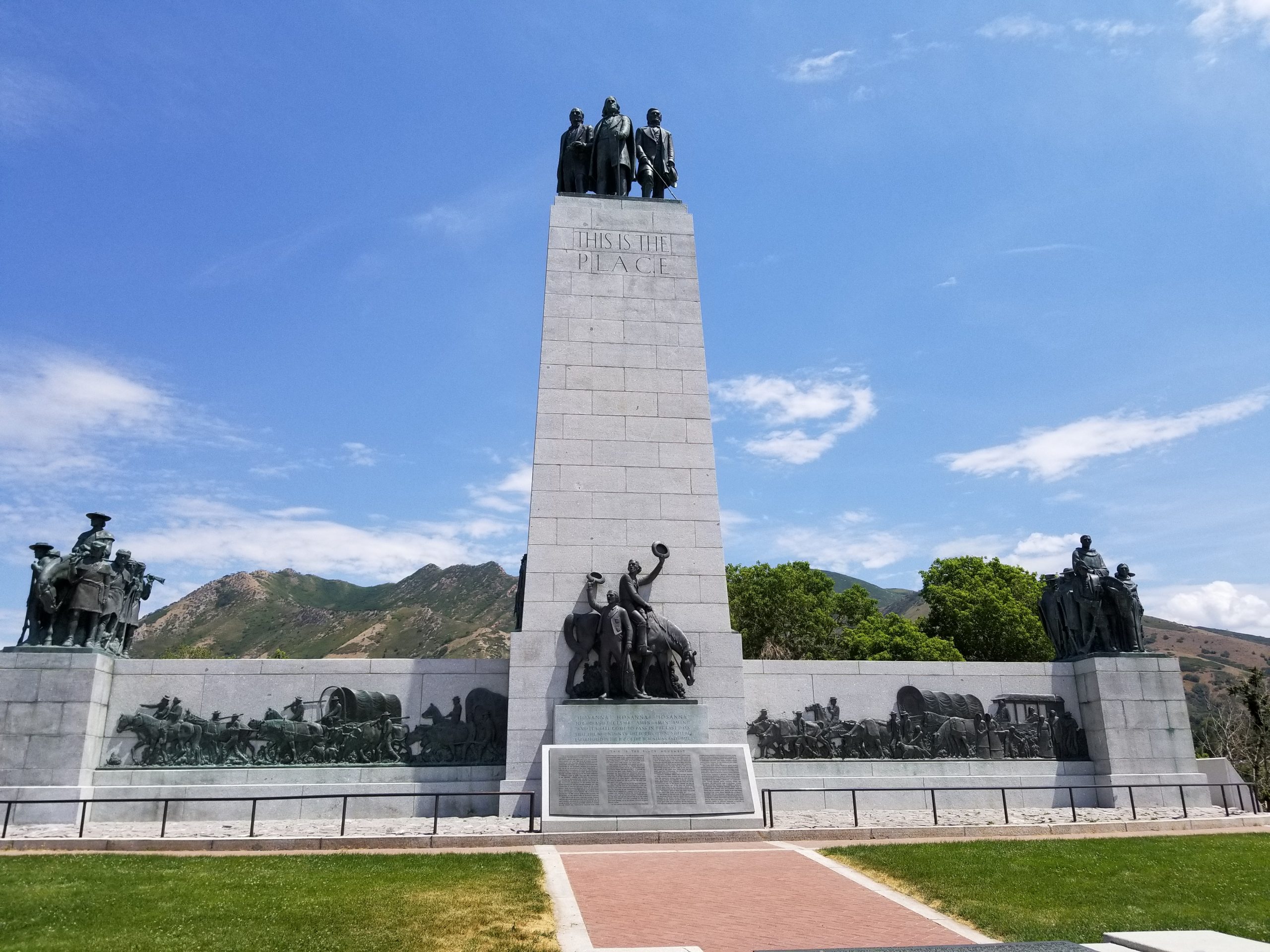
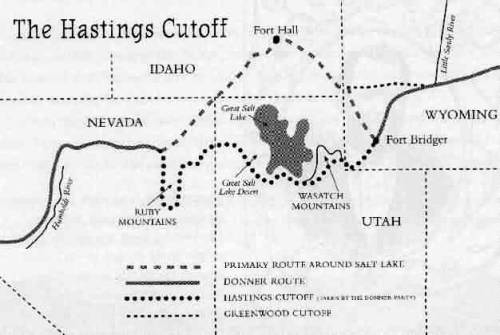
Historical Marker Text: Lured by Lansford Hasting’s assurance that his shortcut from the well-known trail to Oregon and California would save 250 miles and weeks of travel, the ill-fated Donner-Reed party reached this place August 23, 1846, after spending 16 days to hack out a 36-mile road through the Wasatch Mountains. Here at this narrow mouth of the canyon, they were stopped by what seemed impenetrable brush and boulders. Bone-weary of that kind of labor, they decided instead to goad the oxen to climb the hill in front of you. Twelve-year-old Virginia Reed, later recalled that nearly every yoke of oxen was required to pull each of the party’s twenty-three wagons up the hill. After this ordeal, the oxen needed rest, but there was no time. The party pushed on to the Salt Flats, where many of the oxen gave out. This caused delays, which led to disaster in the Sierra Mountains.
A year later, July 22, 1847, Brigham Young’s
Pioneer Party, following the Donners and benefitting from their labor, reached
this spot. William Clayton recorded their decision: “We found the road crossing
the creek again to the south and then ascending a very steep, high hill. It is
so very steep as to be almost impossible for heavy wagons to ascend…Colonel
Markham and another man went over the hill and returned up the canyon to see if
a road cannot be cut through and avoid this hill. Brother Markham says a good
road can soon be made through the bushes some ten or fifteen rods. A number of
men went to work immediately to make the road…After spending about four hours
of labor the brethren succeeded in cutting a pretty good road along the creek
and the wagons proceeded on.”
Donner Hill looking east towards Emigration Canyon
Among the lesson learned that day was one
stated succinctly by Virginia Reed in a letter to prospective emigrants back
home: “Hurry along as fast as you can, and never take no shortcuts.”
Extended Research:
In 1846 a wagon
party led by George Donner departed Independence, Missouri and began a perilous
journey from the United States towards Alta California in Mexico. The wagons
were late in reaching the Sierra Nevada mountain range and disaster awaited the
88 members of the Donner Party. Extreme suffering and starvation followed, with
41 members of the group dying and eventually the incident drew national
attention over reports that some members of the ill-fated party resorted to cannibalism
in order to survive.[2] The
Donner Party originally planned to travel to California via Oregon, but real
estate speculator Lansford Hastings promoted an alternate route published in
his famous Emigrants Guide to Oregon and
California in 1845, and the Donner Party opted to try it.³
Hastings was not
certain if he should promote the cutoff from Fort Bridger through the Salt Lake
Valley and westward following John C. Fremont’s expedition in 1845, but he
received support in favor of the cutoff from Fremont and Jim Bridger. Hastings
thus advised the Donner-Reed party that they would save some 350-400 miles if
they took his “cutoff.” One of his partners, James Clyman, however became convinced
that the route was not suited for wagons and therefore tried to dissuade
members of Donner-Reed Party from taking the cutoff. Joseph R. Walker, who
successfully guided the first wagons over the California Trail by way of Fort
Hall, also thought the route an unproven risk.[3]
Other migrant groups, which included the Bryant-Russell Party and Harlan-Young wagons, left Fort Bridger in mid-July 1848, following the Bear River into East Canyon where they passed through Devil’s Gate with difficulty along the Weber River. Hastings subsequently directed a group of German migrants from the Heinrich Lienhard party on a direct route through Echo Canyon into Devil’s Gate, where they caught up with the Harlan-Young party near the Jordan River. The Donner Party departed Fort Bridger two weeks later on July 31 and Hastings talked them out of going via Weber Canyon and Devil’s Gate, instead telling them to blaze a new path over to what would come to be called Emigration Canyon. On August 7, 1846, James Reed began carving a trail for the wagon train, chopping down bushes and trees in the Wasatch Mountains towards the canyon. Reed was joined by the remaining members of the wagon party who continued to hack and dig their way for 35 miles from present-day Henefer, Summit County, to Salt Lake City.²
Emigration Creek along Donner Hill
The
Bryant-Russell,
Harlan-Young and Lienhard parties would successfully pass through the Sierra Nevada
Mountains into California, while the time the Donner Party spent trailblazing
in Utah foreshadowed later events. After the three
week trek through the Wasatch Mountains, the oxen were already exhausted and
their supplies began to run low.
After entering
the Salt Lake Valley, the first member of the party died of tuberculosis near
the Great Salt Lake. A site near Grantsville, Utah provided temporary relief
with underground water springs, their last source of water until reaching the
Humboldt River. In the Salt Flats, Reed’s thirsty oxen ran off and were never
seen again. Upon reaching Iron Hill, a fight broke out between one of Reed’s
teamsters and John Snyder, a driver for the Graves wagon. Reed stabbed Snyder
in the chest and was banished by the Donners after Snyder died. Reed thus
avoided being pinned down by the early winter storms which trapped the rest of
the party. His departure in October towards Sutter’s Fort allowed him to organize
a rescue party in Sacramento that arrived in February 1847. Along the Humboldt
River a band of Paiute Indians killed 21 of the Donner Party’s oxen and stole
another 18, with more than 100 of the party’s cattle now gone. Two Indian
guides assisted the Donner Party in reaching the summit of the Sierra Nevada,
but turned back with the first sign of snowfall in early November.1
Donner-Reed Party burial remains discovered in the Salt Lake Desert
The
delayed timing and trek through the west desert led to the party becoming
snowbound in the Sierras. Malnutrition was a common cause of death, and Irish
immigrant Patrick Breen wrote in his journal on Christmas Eve that he was
living in a “Camp of Death”.1 Some of the members of
the party camped along the banks of Alder Creek and frozen Truckee Lake, now
Donner Lake, where most of the cannibalism occurred. The first rescuers arrived
at Truckee Lake in February 1847, composed of soldiers from the U.S. Army
stationed in California during the U.S.-Mexican War, among them were members of
the Mormon Battalion. One week after rescuers arrived, other isolated camp
sites were still using the corpses of the dead for food. Breen wrote in his
diary on February 26:
Martha’s jaw swelled with the toothache: hungry times in camp; plenty hides, but the folks will not eat them. We eat them with a tolerable good apetite. Thanks be to Almighty God. Amen. Mrs Murphy said here yesterday that [she] thought she would Commence on Milt. & eat him. I don’t [think] that she has done so yet; it is distressing. The Donners, 4 days ago, told the California folks that they[would] commence to eat the dead people if they did not succeed, that day or next, in finding their cattle.1
Patrick Breen’s diary entry describing the routine cannibalism in the encampment
Three additional relief efforts occurred in April in an attempt to find members who had become separated while camping along Truckee Lake. In the last effort they found only one survivor, Louis Keesberg, who was surrounded by half-eaten corpses. As the survivors departed with the rescuers, members of the Mormon Battalion were ordered to bury the dead bodies inside the main cabin on what is today Donner Pass and then set fire to the cabin.[4]
The Donner Party, in essence, blazed the trail into the Salt Lake Valley which Brigham Young and the Mormon Pioneers used the following year. Young left Winter Quarters, Nebraska with his encampment and passed through the mouth of Echo Canyon by mid-July 1847; he then picked up the Donner-Reed trail and followed it into the Salt Lake Valley. Instead of three weeks, it took Young’s party one week, a matter of great importance since it enabled the Mormons to plant wheat and potato crops in time for their first harvest in the fall. In the last quarter-mile, rather than hauling their wagons over Donner Hill, the Mormons decided to hack through the brush and go around Donner Hill. The Mormons emerged four hours later at what is now This is the Place State Park.[5]
For Further Reference:
Primary
Sources:
Breen, Patrick. Diary of
Patrick Breen of the Donner Party, 1846-7. Berkeley: University of California
Bancroft Library, 1910.
Secondary
Sources:
Campbell,
Eugene. “The Mormons and the Donner Party.” BYU
Studies Quarterly, Vol. 11 no. 3 (1971).
Miller,
David. “The Donner Road through the Great Salt Lake Desert.” Pacific Historical Review, Vol. 27, no. 1 (February 1958): 39-44
[1] Originally installed by “Mormon Explorers” Y.M.M.I.A. In
2010, the original plaque was stolen and re-erected in 2016 by the LDS 38th
North Ward High Priests
Placed by: The University of Utah Alumni Association
GPS Coordinates: Latitude: 40º 45’ 51.702” N Longitude 111º 50’ 58.59” W
Historical Marker Text
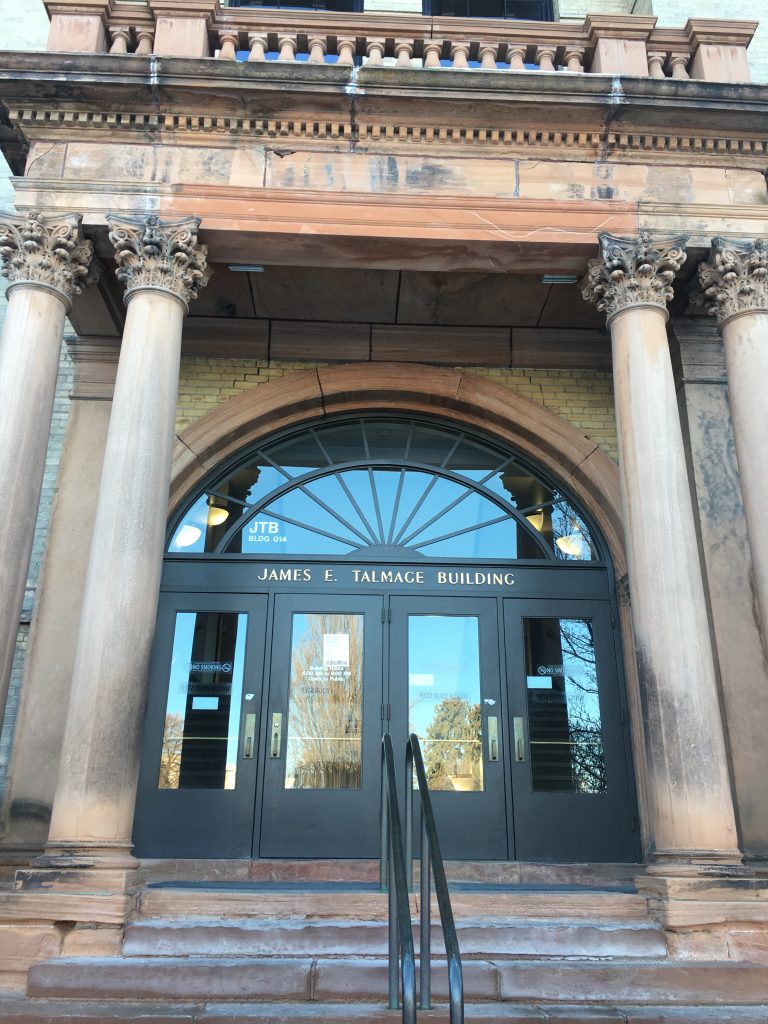
James E. Talmage-scholar, scientist, educator, author, and church leader-was born in England and came to Utah when he was ten years old. He earned the A.B degree at Lehigh University. and the Ph.D at Illinois Wesleyan University. For his work in chemistry and geology he was elected to membership in the Royal Society of Edinbirgh. He gave vigorous leadership to the University as Professor of metallurgy and biology, as Deseret professor of geology and as the University’s second president from 1894 to 1897. His major educational concern was to build a sound system of teaching for the people of Utah who, in the 1880’s were still somewhat remote from the established centers of learning, and to incorporate into the University curriculum the expanding body of scientific knowledge.
The land on which this building stands was deeded to the University during President Talmage’s administration. Construction of the building, to be known as the Museum, was begun in 1900, but so many new buildings were going up in Salt Lake City that skilled laborers and quality brick and stone were in short supply. The building was not completed until late in 1902.
The Museum building contained classrooms, offices and laboratories for biology, geology and mineralogy; geological and biological museums; an assembly room and gymnasium. About 1920, geology classes were relocated and the Museum become known as the Biology Building until, on June, 1976 in ceremonies sponsored by the Alumni Association, it was officially named the James E. Talmage building.
Extended Research:
James E. Talmage was a respected member of the academic community as well as a leader in the Church of Jesus Christ of Latter-day Saints. Talmage was the fourth president of The University of Utah from 1894-1897 but it was not until 1976 that the building was named the James E. Talmage building.
Talmage had a life full of educational and academic success. He grew up in Provo, Utah and worked at Brigham Young Academy (now Brigham Young University). He had a love of knowledge and pursued degrees in chemistry and geology. He studied at Leigh University and Johns Hopkins University. He became one of the first Mormons to receive a PhD.1 After his time as president of the University of Utah he was called to the Quorum of the Twelve Apostles of the Church of Jesus Christ of Latter-day Saints. While he was an apostle he also published a book well known in the Church called Jesus the Christ.
He took his job as University of Utah president very seriously and in correspondence with Elder John M. Whitaker he mentioned that it was “hard for me to do any lecturing outside the regular lectures at the institution”.2 He worked hard and he accomplished a lot in his academic life and took his job very seriously as president of the university. He was busy in his church life as well as home life as he was a father to eight children. Eventually he died from inflammation of the heart on 21 July 1933.3
The James E. Talmage building’s purpose changed over time. It was first erected as a museum building in 1902 but has primarily served as a science building. The building was built by architects Samuel C. Dallas and Williams S. Hedges who designed the building in a second renaissance revival style as the unique columns in the front of the building attest.4
The medical school took over use of the building from 1905-1920. In 1959 it was changed to the biology building to accommodate classrooms for a growing student population. Then in 1976 the building was renamed the James E. Talmage building in honor of the former university president. It is located in President’s Circle and the building is still used for science related studies.5
1 Bowman, Matthew Burton. The Mormon People: The Making of an American Faith. New York: Random House, 2012.
2 “Correspondence between John Mills Whitaker and James E. Talmage.” James E. Talmage to John Mills Whitaker. January 25, 1894.
“Correspondence between John Mills Whitaker and James E. Talmage.” James E. Talmage to John Mills Whitaker. January 25, 1894. https://collections.lib.utah.edu/details?id=917332
Address: 5189 South State Street, Murray, UT 84107
Erected in 1960 by the Daughters of Utah Pioneers association.
Historical Marker Text : The Pony Express epoch began simultaneously April 3, 1860 with riders starting at St. Joseph, Missouri, and San Francisco, California. It was a 1966 mile journey and reduced the time of transmitting news across the country from approximately 21 to 10 days. Nearly one hundred stations were established. This spot marks the first station south of Salt Lake City. It was a small adobe building known as Travelers’ Rest. Here riders exchanged horses and received needed repairs, food, or lodging. With the inception of telegraph the pony express was abolished in October, 1861.
Extended Research
Distributing mail was a difficult and expensive task in the nineteenth century, especially from the eastern United States to the West. It was also a dangerous task due to the challenging terrain, harsh weather, and potential attacks from bandits. Designed to meet these challenges and overcome them, the United States contracted with a major American freight company, Russell, Majors, and Waddell, which established the Pony Express in April 1860. There were multiple express stations built between San Francisco, California and St. Joseph’s, Missouri. At these stations riders could get a fresh horse, rest, obtain food, and hurry on their way. It normally took more than three weeks by stagecoach to deliver the mail but the Pony Express made it possible to travel nearly 2,000 miles within ten days [1].
Although the Pony Express was very successful, there were still some dangers that the riders faced. There were some people who would try to steal the mail that the riders carried with them, sometimes resulting in violence. A Pony Express rider named George S. Stiers stated in one of his journal entries, that he encountered multiple men who tried to steal from him while on his way to deliver mail [2]. He worked as a mail carrier for three years but had to quit because the man who hired him didn’t want to be at fault for Stiers’ death during the delivery of mail.
Utah Territory was an important crossroads on the Pony Express route. “Salt Lake City was a major population center between the Missouri River and the West Coast”[5]. The Kansas based mail delivery firm, Russell, Majors, and Waddell created the Pony Express stations between St. Joseph’s, Missouri and Salt Lake City and from there to Sacramento.[4]. Most of the men who delivered the mail were young and some of them were from Salt Lake City. With Utah Territory’s population of around 40,000 people in 1860, the Pony Express carried many letters from the territory. In total, the Pony Express managed to deliver over 30,000 letters during the eighteen months that it was in business.
The Saddles that carried the mail
The Pony Express was successful in reducing the time it took to receive mail but it was not profitable. The completion of the transcontinental telegraph in October 1861 meant that the Pony Express was no longer needed. According to a journal entry by Captain J.H. Simpson, the telegraph used the same basic trail that the Pony Express had used and converted some of the Pony Express stations into telegraph stations [6].
Flyers requesting men to work in the Pony Express
The Pony Express should be remembered as an important advance in speeding the time it took to get news and information across the United States. At the time, nothing had ever been delivered so fast as the mail with the Pony Express. In the twenty first century, there are many methods to deliver things quickly like airplanes or cellphones. The fast delivery of the Pony Express was an important innovation for the nineteenth century like cell phones and airplanes are for people today. The Pony Express is also a symbol of the old West, especially an iconic man on a horse racing across the desert. It symbolizes masculinity, strength, and conquest and embodies many of the myths of the West.
The Pony Express Station in Murray, Utah was significant enough to get its own historical marker because it was one of the places where the riders could stop and relax. There were some stations that were dangerous due to their location, but the station in Murray was known for its safety and as a good place to rest. It was also the first station South of Salt Lake City to be established.
Simpson, J. H. Report of Explorations across the Great Basin of the Territory of Utah :for a Direct Wagon-Route from Camp Floyd to Genoa, in Carson Valley, in 1859 /by Captain J. H. Simpson. Made by Authority of the Secretary of War and under Instructions from Bvt. Brig. Gen. A. S. Johnston., 1876. https://archive.org/details/reportofexplorat00simp/page/n10
Fike, Richard E., and John W. Headley. The Pony Express Stations of Utah in Historical Perspective. Dept. of the Interior, Bureau of Land Management, 1979. URL: https://hdl.handle.net/2027/umn.31951002854172y
Placed by: Division of State History (national register)
GPS Coordinates: 40.6353494, -111.8640506
Historical Marker Text (Currently not on Display):
Utah Historic Site: Henry J. Wheeler Farm
The Henry J. Wheeler Farm is one of the best remaining examples of a turn of the century farmstead in the Salt Lake Valley. The farm was developed after the marriage of Henry J. Wheeler and Sariah Pixton in 1886. The modest Victorian style house was constructed in 1898 for the Wheelers by Sid Gills and Hans Yorgensen. In 1969 the farm was acquired by the Salt Lake County Recreation Department. Development of the property as a historical farm and recreational complex began in 1976.
Extended Research:
In 1886 Henry J. Wheeler and his wife Sariah established their farmstead in the Little Cottonwood area, on current day 900 East and 6351 South. First generation children of pioneers, Henry and Sariah’s families emigrated to Utah within the first decade of LDS settlement. Henry’s family traveled to the new territory from England in 1852, while Sariah’s family traveled to Utah under the leadership of Brigham Young in 1848. Sariah’s mother, Elizabeth, traveled alone in this company, driving the wagon herself the entire way.[2]Henry and Sariah married in 1886, setting up their farm shortly thereafter.
The farm originally consisted of seventy seven acres, with Little Cottonwood Creek providing irrigation for the land.[3]The semi-arid landscape of Utah required Henry to respond creatively to the needs of his land, and as such he chose to diversify the property and the holdings. Wheeler included sheep, orchards, ice, and dairy distribution as part of his farm which made him both successful and progressive.[4]Originally the farm included a small adobe dwelling, however Sariah dreamed of more. She wanted a house in the grand victorian style, and eventually this dream became a reality. In 1898 the Wheelers built the victorian style mansion which stands on the property today. Henry Wheeler credited the design of the house to Sariah’s knowledge of architecture.[5] The finished structure boasted ten rooms, and was made of adobe and brick. The family pulled the adobe from their previous house, using it to insulate the new house. The victorian house therefore stood tall and strong, and the adobe provided good insulation for cold winter months.[6]
During the height of the farm Henry built many out buildings which contributed to the success of his farm. These included an ice house, various barns, and a garage for his Pierce Arrow automobile. The victorian mansion also provided a cozy space to host the Wheeler’s seven children. Henry Wheeler trained his dog to fetch the mail and newspaper from the mailbox, to the amusement and delight of his grandchildren.[7] Sariah Wheeler’s expansive dining room became a gathering place for her family and extended family. Sariah’s table sat up to twenty people and during Thanksgiving she served her children and grandchildren a dinner made from turkey raised on the farm and weighing forty pounds.[8]
Picture Circa 1900. Henry Wheeler’s dogs and Farmhouse in the Background.[9]
After the death of Henry Sr. in 1943 the farm was purchased by Richard Madsen (owner of Sterling Furniture Company). During this time it became a dairy and cattle ranch. In 1969 Salt Lake County purchased the farm with plans to turn the property into a sports and park complex. Luckily, in 1974 the Junior League of Salt Lake asked the county if they could preserve the farm, much of which (including the buildings) had fallen into disrepair. After extensive research and renovation the farm was included on the National Historic Registry, and opened to the public officially in 1976 as Wheeler Historic Farm.[10]
Since it’s opening as a preserved site, the farm has provided visitors with a glimpse of what farm life was like in the Salt Lake Valley between 1880 and 1910. The farm boasts a collection of almost 6,000 farming artifacts important to the history of Utah farming. It also houses animals such as sheep, goats, horses, cows, turkeys and chickens. The farm has engaged in community outreach and learning, including renting out garden plots, grassroots music festivals, Sunday farmers markets and Halloween corn mazes.[11]Meticulously preserved, visitors can tour Sariah’s grand Victorian farmhouse for a nominal fee Monday through Friday. Visitors can lead themselves on a self-guided tour through the rest of the farm any day of the week. The farm continues to provide glimpses into Utah’s past, as well as a place of learning and gathering for Utah families.
For Further Reference
Primary Sources
Biographical Record of Salt Lake City and Vicinity: Containing Biographies of Well Known Citizens of the Past and Present. (National Historical Record,1902), 429.
Mastrim, Beverly Wheeler. A number of oral interviews with Ms. Mastrim are available on the Salt Lake County Website
Secondary Sources
“Family Gardening,” Salt Lake Community College Newspaper(Salt Lake City, UT), October 4, 1989.
Lamborn, John E. and Peterson, Charles S. “The Subsistence of the Land: Agriculture v. Industry in the Smelter Cases of 1904 and 1906” Utah Historical Quarterly53 (1985): 310.
[2]Biographical Record of Salt Lake City and Vicinity: Containing Biographies of Well Known Citizens of the Past and Present, (National Historical Record, 1902), 429.
[4]John E. Lamborn and Charles S. Peterson. “The Subsistence of the Land: Agriculture v. Industry in the Smelter Cases of 1904 and 1906” Utah Historical Quarterly53 (1985): 310.
[5]Biographical Record of Salt Lake City and Vicinity: Containing Biographies of Well Known Citizens of the past and Present. (National Historical Record,1902), 429.
[11]“Family Gardening,” Salt Lake Community College Newspaper(Salt Lake City, UT), October 4, 1989 and Salt Lake County, “Story of Wheeler Historic Farm.”
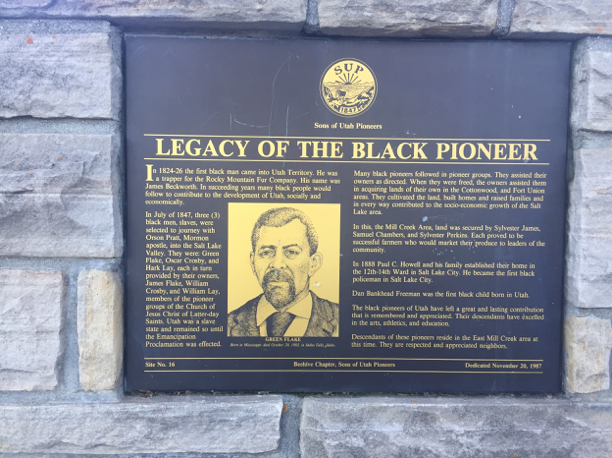
Plaque at marker for Legacy of the Black Pioneer[1]
Placed by:Beehive Chapter, Sons of Utah Pioneers and dedicated November 20, 1987.
GPS coordinates:40.6967660, -111.8272168
Historical Marker Text
In 1824-26 the first black man came into Utah Territory. He was a trapper for the rocky Mountain Fur Company. His name was James Beckwourth. In succeeding years many black people would follow to contribute to the development of Utah, socially and economically.
In July of 1847, three (3) black men, slaves, were selected to journey with Orson Pratt, Mormon apostle, into the Salt Lake Valley. They were: Green Flake, Oscar Crosby, and Hark Lay, each in turn provided by their owners, James Flake, William Crosby, and William Lay, members of the pioneer groups of the Church of Jesus Christ of Latter-day Saints. Utah was a slave state and remained so until the Emancipation Proclamation was effected.
Many black pioneers followed in pioneer groups. They assisted their owners as directed. When they were freed, the owners assisted them in acquiring lands of their own in the Cottonwood, and Fort Union areas. They cultivated the land, built homes and raised families and in every way contributed to the socio-economic growth of the Salt Lake area.
In this, the Mill Creek Area, land was secured by Sylvester James, Samuel Chambers, and Sylvester Perkins. Each proved to be successful farmers who would market their produce to leaders of the community.
In 1888 Paul C. Howell and his family established their home in the 12th-14th Ward in Salt Lake City. He became the first black policeman in Salt Lake City.
Dan Bankhead Freeman was the first black child born in Utah.
The black pioneers of Utah have left a great and lasting contribution that is remembered and appreciated. Their descendants have excelled in the arts, athletics, and education.
Descendants of these pioneers reside in the East Mill Creek area at this time. They are respected and appreciated neighbors.
Between the years of 1824-26 James Beckwourth traveled with the Rocky Mountain Fur Company into what became Utah Territory. Beckwourth styled himself an explorer, fur trapper, and Indian Fighter; he was also a free man of color. Beckwourth had not always been free. Born into slavery in 1798, Beckwourth moved to Missouri with his family in 1805. In Missouri, at the age of 19 Beckwourth’s father, who was also his master, freed him from slavery. Freedom allowed Beckwourth to realize his dreams to move West as an explorer.[3]James P. Beckwourth may have been one of the first African American men to step foot into what became Utah, but he was not the last African American pioneer.
While the Legacy of the Black Pioneer plaque lists the names of three enslaved African American men (Green Flake, Oscar Crosby, and Hark Lay) who in 1847 arrived in Utah with their enslavers, it does not indicate that free men and women of color also made the trek to Utah in the same year. Notably, the year 1847 also brought the arrival of the Haight Company. This company included Jane Elizabeth Manning James, her husband Isaac, their son Silas, and Jane’s son Sylvester. Born a free woman, Mormon Missionaries converted James and her family to the Church of Jesus Christ of Latter-day Saints in 1842. She was one of a handful of African American converts from Wilton, Connecticut. A year after converting, Jane and many members of her family trekked to Nauvoo, Illinois. There, in 1843 Jane became a domestic servant in the Joseph Smith household.
Arriving in the Salt Lake Valley in 1847, James was a central figure in the African American Mormon community. James contributed to the building funds for temples and strongly advocated for her rights to receive ordinances and sacraments denied to her within those temples. In 1897 James was honored as one of the original Mormon Pioneers.[4]
As Jane and Isaac demonstrate, both enslaved African Americans and free African Americans arrived in the Salt Lake valley in 1847. The historical marker also incorrectly indicates that Utah was a slave “state” until the Emancipation Proclamation. First, the Federal Government had not granted Utah statehood prior to the American Civil War. Utah gained statehood in 1896, over thirty years after the Thirteenth Amendment granted legal emancipation and banned slavery. However, Utah gained territorial status in the Compromise of 1850. This Compromise also gave Utah the ability to determine whether or not the territory would allow slavery.[6]
In 1852 the all Mormon territorial legislature answered the question of slavery when it passed “An Act in Relation to Service.” This act served as a conservative form of gradual emancipation patterned after similar bills in New Jersey, New York, and Pennsylvania. It freed no current enslaved men or women, however the act defined slaves as “servants” and implied that those born after the passage of the bill would not inherit the slave status of their parents. Although Utah’s “Servant Code” legally defined slaves as “servants,” this did not mean that men and women did not enter Utah Territory under enslavement. Some black men and women certainly entered the territory enslaved and the “Servant Code” legalized the process whereby slavery would be regulated in the territory. Interestingly, Utah’s “Servant Code” did require schooling for all servants, including those held in slavery, stating that servants must be schooled “not less than eighteen months between the ages of six years and twenty years.”[7] This was atypical for a space that allowed slavery, especially when compared to states entrenched in enslavement. For example, in 1831 North Carolina passed a law entitled “An Act To Prevent All Persons From Teaching Slaves To Read Or Write, The Use of Figures Excepted.”[8]
In allowing slavery in Utah Territory, LDS leaders sought to create a legal code that allowed converts from the South to migrate to Utah, bringing their enslaved peoples with them, some of whom had also converted to Mormonism.[9]Educating slaves prepared them for citizenship, in turn allowing them to better integrate into Utah Territory. Utah’s “Servant Code” thus legalized slavery in Utah Territory, and lasted from 1852 – 1862, when the federal government abolished slavery in all territories. However, Utah was never a slave state, and Utah’s laws surrounding slavery functioned differently than those in Southern slave states.
In 1850 the census recorded fifty African Americans within Utah Territory, twenty four of whom were enslaved, twenty six of whom were free. In 1860 the total number of African Americans had only risen to fifty nine. Over time, however, the African American population continued to grow. In 1870 Utah had an African American population of 137, and forty years later, in 1910, that number had grown to 1,144.[10]The railroad provided one source of jobs which attracted many newly freed African Americans to Utah, and Utah became home to a flourishing African American community, both LDS and non-LDS. Early black settlers provided Utah with two African American run newspapers, The Broad Ax and the Utah Plain Dealer.
Mill Creek, where this particular historical marker resides, is a wonderful example of African American community and life in Utah. Called “The Hill” by the black community, African Americans lived and farmed in Mill Creek, and the area quickly became a center for black life in the Salt Lake Valley. Some of these families, like the family of Samuel Davidson Chambers had converted to Mormonism during the period of their enslavement. After freedom came in 1865 Samuel sharecropped and cobbled shoes until he earned enough money for his family to “gather” in Utah Territory.[11] Others, like Ned Leggroan and his family, moved to Utah Territory with extended kin and sought better opportunities outside of the South. The Chambers and Leggroan family were the first black farmers in Mill Creek. Samuel Davidson Chambers purchased property in Mill Creek in 1875, with Ned Leggroan purchasing land in 1889.[12] Black families on “The Hill” farmed fruit and vegetables, and made extra money through produce and the butchering of animals. The families lived on land which now makes up Evergreen Avenue in Mill Creek. By most oral accounts African American families lived next to white families and the community was generally inclusive.[13]Descendants of African American pioneers lived and farmed in Mill Creek until the middle of the twentieth century. By this time many families had moved elsewhere in the Salt Lake Valley in search of jobs and economic opportunities outside of farming.
By 2010 the African American population in Utah had expanded to 29,287.[14]African American communities continue to be an integral part of the Utah experience.
“An Act in Relation to Service,” Territorial Legislative Records, 1851-1894, series 3150, microfilm, reel 1, box 1, folder 55, pages 704-706, Utah State Archives, Salt Lake City Utah.
Raleigh,”Act Passed by the General Assembly of the State of North Carolina at the Session of 1830—1831,” 1831.
Secondary Sources
Bonner, T. D. The Life and Adventures of James P. Beckwourth, Mountaineer, Scout, and Pioneer (London: Sampson Lo Son and Co, 1856)
Bringhurst, Newell G. “The Mormons and Slavery: A Closer Look,”Pacific Historical Review, Vol 50, No. 3 (1981): 332
Johnson Karen A. “Undaunted Courage and Faith: The Lives of Three Black Women in the West and Hawaii in the Early 19th Century,” The Journal of African American History91, no. 1 (2006): 4-22
Newell, Quincy D. Your Sister in the Gospel: The Life of Jane Manning James, a Nineteenth-Century Black Mormon. New York: Oxford University Press, 2019.
Perlich, Pamela S. “Utah Minorities: The Story Told by 150 Years of Census Data,” Bureau of Economic and Business Research, David S. Eccles School of Business, University of Utah (2002), 11.
Reiter, Tonya. “Life on the Hill: The Black Farming Families of Mill Creek.” Journal of Mormon History 44No. 4 (October 2018): 68-89
Rich, Christopher B. “The True Policy for Utah: Servitude, Slavery , and ‘An Act in Relation to Service,” Utah Historical Quarterly80 (Winter 2012) 54-74
[3]T. D. Bonner, The Life and Adventures of James P. Beckwourth, Mountaineer, Scout, and Pioneer (London: Sampson Lo Son and Co, 1856) 10.
[4]Karen A. Johnson, “Undaunted Courage and Faith: The Lives of Three Black Women in the West and Hawaii in the Early 19th Century,” The Journal of African American History91, no. 1 (2006): 4-22
[5]Miscellaneous Portraits, Circa 1862-1873. PH 5962, box 1, folder 25, image 37. Church History Library. Church of Jesus Christ of Latter Day Saints. Viewable online at Century of Black Mormons
[9]Newell G. Bringhurst, “The Mormons and Slavery: A Closer Look,” Pacific Historical Review, Vol 50, No. 3 (1981): 332.
[10]Pamela S. Perlich, “Utah Minorities: The Story Told by 150 Years of Census Data,” Bureau of Economic and Business Research, David S. Eccles School of Business, University of Utah (2002), 11.
[11]Tonya Reiter,“Life on the Hill: The Black Farming Families of Mill Creek.” Journal of Mormon History 44No. 4 (October 2018): 70.
These historical markers were erected September 30, 1961 by the Daughters of Utah Pioneers (Central Company). It encompasses four markers.
GPS Coordinates (Latitude/Longitude):
40.7767625°, -111.89043469°
Transcript:
“This monument honors the Utah men who answered the call to protect the mail and telegraph lines along the continental route during the Civil War. April 25, 1862 Acting Governor of Utah, Frank Fuller, called for volunteers from the Nauvoo Legion. The next day twenty-four men under Col. Robert T. Burton left for their assignment. Two days later Brigham Young received an authorization from President Abraham Lincoln, through Secretary-of-War Stanton, for a company of cavalry to serve ninety days protecting the same route. One hundred and six men responded for duty under Captain Lot Smith. Later some Utah men joined the 3rd Regiment, California Volunteers, stationed at Fort Douglas, Oct. 1862-July 1866. Other pioneers served in the Civil War before coming to Utah.”
Transcript:
“Captain Lot Smith Company:
Joseph S. Rawlings, 1st Lt.
J. Q. Knowlton, 2nd Lt.
Richard H. Atwood, 1st Sgt.
James M. Barlow, 2nd Sgt.
Samuel H. W. Riter, Sgt.
Howard Spencer, Sgt.
Moses Thurston, Sgt.
John P. Wimmer, Sgt.
Andrew Bigler, Corp.
Wm. A. Bringhurst, Corp.
Hiram Clemons, Corp.
Joseph H. Felt, Corp.
John Hoagland, Corp.
Newton Myricn, Corp.
John Neff, Jr., Corp.
Seymore P. Young, Corp.
Moroni W. Alexander
William C. Allen
John Arrowsmith
Isaac Atkinson
William Bagley
Lachoneus Barnard
William H. Bess
John R. Bennion
Samuel R. Bennion
Henry Bird
Edwin Brown
Charles C. Burnham
John Cahoon
Theo J. Calkin
Thomas S. Caldwell
Francis R. Cantwell
Jesse J. Cherry
Peter Cornia
George Cotterell
Everet Covert
James H. Cragun
Charles Crismon Jr.
George W. Davidson
Albert Davis
Henry L. Dolton
Parley P. Draper
Josiah Eardley
Charles Evans”
Transcript:
“Captain Lot Smith Company:
Joseph A. Fisher
Wid Fuller
John Gibson
Moses W. Gibson
Joseph Goddard
William Grant
James Green
Edward F. M. Guest
Solomon Hale
Thomas H. Harris
John Helm
Samuel Hill
Ira N. Hinckley
James S. Hixson
Richard Howe
Louis A. Huffaker
Harvey C. Hullinger
James Imlay
Lars Jensen
Powell Johnson
Hiram Kimball, Jr.
Wm. J. Larkins
Thurston Larsen
Leander Lemmon
Daniel C. Lill
Wm. Longstrough
Thomas Lutz
William W. Lutz
William Lynch
Elijah Maxfield
Edwin Merrill
Reuben P. Miller
Mark Murphy
Daniel McNicol
Benjamin Neff
Edward A. Noble
Hiram G. North
Lewis Osborn
Hugh D. Park
Francis Platt
Lewis Polmantur
Francis Prince
Alfred Randall
Adelbert Rice”
Transcript:
“Captain Lot Smith Company:
Landon Rich
Wm. H. Rhodes
Alley S. Rose
James Sharp
Emerson D. Shurtleff
Harlon E. Simon
John Standiford
James H. Steed
Joseph J. Taylor
Joseph Terry
William Terry
John H. Walker
William H. Walton
E. Malin Weiler
James H. Wells
Bateman H. Williams
Ephrain H. Williams
Col. Robert T. Burton Company:
Heber P. Kimball, Lt.
Robert J. Golding, Sgt.
Joseph M. Simmons, Sgt.
John W. Woolley, Sgt.
Stephen Taylor, Corp.
James T. Allred
William Carlos
Mark Croxall
Lewis Grant
William J. Harris
Henry Heath
Richard D. Margetts
Orson P. Miles
Lewis N. Neeley
Samuel D. Serrine
Adam Sharp
George Spencer
Joshua Terry
George W. Thatcher
Lewis A. West
James Woods
Brigham Young, Jr.
John W. Young”
Utah and the Civil War Marker (2015), Utah Civil War Casualty:
This historical marker was erected on November 11, 2015 by the Daughters of the Utah Pioneers (International). It was added as part of the Utah and the Civil War Markers (1961).
GPS Coordinates (Latitude/Longitude):
40.7767625°, -111.89043469°
Transcript:
“Lieutenant Henry Wells Jackson (March 10, 1827- May 27, 1864), was the only Utah battle fatality of the Civil War and the first known Latter-Day Saint to be killed in a U.S. national conflict. Jackson marched in the Mormon Battalion, Company D, musician; panned for gold at Mormon Island (now Folsom Lake), California; and used gold to pay for his wedding. He and Eliza Ann Dibble were married in Salt Lake on February 3, 1850, by Brigham Young. Henry and Eliza started a family and helped establish settlements in Tooele Valley and San Bernardino, California. In 1858, Henry carried mail for George Chorpenning on the Overland Mail Route, a precursor to the Pony Express. Due to bad management, Henry was owed $1,300 in back pay for his mail service. He decided to go back East to try and collect the money. Payment was delayed, so Henry took employment as a wagon master and was ultimately captured by the Confederate Army and held as a prisoner for three months. He was later released in exchange for Confederate prisoners. Because of the way he was treated, he decided to fight for the Union. Henry enlisted with the First Regiment, District of Columbia, Volunteer Cavalry and was commissioned as a lieutenant due to his previous service in the Mormon Battalion. On May 8, 1864, Henry took part in the Battle of White Bridge near Jarrett’s Station, Virginia, and was shot. Due to infection, he died on May 27, 1864, leaving behind his wife and three children. Henry Wells Jackson is buried in Hampton National Cemetery and is remembered for his great sacrifice and love for family and country.”
Extended Research:
On April 12, 1861, the United States descended into a civil war, portrayed in the contemporary perception as a conflict between an industrial north and a slaveholding south. With this perception, it is often thought of as a war in the southern and eastern United States, excluding the American West from discussion about this uncivil bloodshed. While the American Civil War and its cruel battles remained mainly in the eastern portion of the country, people from its western territories and states participated in various manners. Utah’s role was small and limited, enacting its state militia for only a 90-day service before federal troops from California assumed responsibility. Members of the Nauvoo Legion were ordered to protect the telegraph lines and the overland trails. While the militia accomplished little in terms of warfare, the Nauvoo Legion’s participation helped provide a counterpoint to the American perception about members of the Church of Jesus Christ of Latter-day Saints’ loyalty to the United States.
Questions about Latter-day Saints shifted into doubts regarding the loyalty of Latter-day Saints to the Union. Prior to the Civil War, they were viewed as alien to the ideal American community, which was white and Protestant.[1] During the war, this perception became coupled with heavy suspicions that Latter-day Saints collaborated with the Confederates. For example, the governor of Nebraska Territory wrote of “Mormon emigrants,” who “sympathize warmly with the secessionists” and, “If they were disposed to make common cause with the secessionists in our own Territory and Missouri, the Indians also becoming their allies, they could easily exterminate the whole loyal population between the Missouri River and the Rocky Mountains before relief could be obtained from the Government.”[2] It was not enough that the group traveling through Nebraska were emigrants. They were “Mormon emigrants” who would ally with Native Americans, reflecting the idea that Latter-day Saints were not white through their associations and beliefs about Native Americans in their religious text, “The Book of Mormon.”[3] The religious people were contrary to the ideal American community, which suggested in the eyes of the public that they must be secessionists too. Perhaps, therefore, Simon Cameron reminded President Abraham Lincoln of the Utah War and recommended that another army should be sent to Utah to prevent violence by Latter-day Saints.[4] The “Mormon Problem” expressed before the war became a question of doubt about loyalty.
Latter-day Saint disloyalty came from their understanding of themselves as a persecuted people. In December 1861, Brigham Young, speaking in the Salt Lake Tabernacle, stated clearly that “never was a wickeder man than the President of the United States, and his associates are very wicked men.”[5] However, Brigham’s words were to express his disdain for the “Gentile” territorial leaders that lived in the state, believing them to have engaged in misconduct against the Latter-day Saints.[6] It reflected his desire for Utah statehood and the corresponding right for Latter-day Saints to govern themselves. Heber C. Kimball, an early Latter-day Saint leader, declared that while he did not pray for the destruction of the government of the United States, he knew that “dissolution, sorrow, weeping and distress are in store for the inhabitants of the United States, because of their conduct towards the people of God.”[7]
For Latter-day Saints, the Civil War thus brought a reliving of previous abuses and a reminder of the recent Utah War where the nation, in their eyes, turned against them once more. As a result, it was easy for Latter-day Saints to view the Civil War as God’s justice enacted against the United States when the war erupted. This is evident in an editorial likely penned by George Q. Cannon, which stated, “Already our boasted land of liberty… is deluged with blood, and will continue to be so until it has atoned for rejecting the Gospel and refusing to avenge the wrongs of our people, and for passively sanctioning the murder of God’s servants.”[8] The Civil War, in the early Latter-day Saint perspective, was justified for the murder of their prophet, Joseph Smith, as well as other abuses. These expressions of frustration, however, when viewed by the American public were seen as further evidence of LDS disloyalty.
Yet as much as Latter-day Saints expressed fiery indignation toward the United States for their “abuses,” there was a fair amount of conciliation and sympathy as well. Brigham Young did express sorrow for the people in the East.[9] Though angry at the United States federal government, Brigham affirmed Latter-day Saint loyalty to the country. He felt that it was better that his people submitted “to those things which are [unpleasant] than for us to do wrong” when asked if the Utah Territory would secede.[10] His first telegram to the United States reaffirmed Utah’s loyalty to the Constitution and the laws of the land.[11] To help affirm Latter-day Saint allegiance to the Union in the minds of the American people, he offered the Nauvoo Legion as an aid.
President Abraham Lincoln—tasked with the reunification of the country—knew that the survival of the United States rested on maintaining the loyalty of the states and territories remaining in the Union.[12] Part of Lincoln’s duty was to ensure communication lines with the western states and territories remained open. As workers built the transcontinental telegraph, Lincoln realized its importance. During its construction, he had the lines shifted more towards the north, putting the route through Salt Lake City.[13] Moving the route enabled the transcontinental telegraph line to remain open and free from interruptions. If this was not accomplished, communicating with the people in the West would prove long and tedious as it would more likely be done through messengers on horse. It would add further strains to an already stressed country.
It was not only President Lincoln who saw the vitality of communication with the West. Politicians, too, noted its importance. On May 1, 1861, Erastus Corning, an American politician, wrote a letter to Simon Cameron (the Secretary of War at the beginning of the American Civil War) stating:
I also think that it is of vital importance to the Government that the Hannibal and Saint Joseph Railroad be preserved to its owners, and that its free and uninterrupted use be maintained at all times and at all hazards. It furnishes the only accessible and speedy route by which the Government can communicate with Kansas, Nebraska, and Utah, or with its military posts along the Western and Northwestern frontier to the foot of the Rocky Mountains, and, if allowed to fall into and remain in the hands of an enemy, it is easy to see how difficult and well-nigh impossible in such an emergency it would be for the Government to preserve its Western Territories and military posts, for the danger to which they would be exposed would indeed be serious, and they could only be supported at immense expense and loss both of time and of means.[14]
However, the trouble did not come from Confederate sympathizers, but from Native Americans. For Native Americans, there was a desperate struggle to survive on dwindling resources as settlers encroached on their territory. Competition for natural resources taxed the natives as more settlers entered Utah.[15] The United States made treaties with the various tribes that comprised Utah territory in disadvantageous ways. They were written in English with terms not explained correctly and made with Native Americans who did not lead the tribe.[16] These treaties often faltered. Reservations were never maintained properly with living conditions proving difficult.[17] It pushed some Native American people to raid emigrant trains and cause general mayhem. For these reasons, Native Americans disrupted communications even prior to the war. During the war it proved alarming as Native Americans in the eastern United States sided with both the Union and the Confederates. There was a legitimate fear that native peoples in the West would join the Confederate cause and eliminate those loyal to the Union.
Feeding Native American peoples would not prove to be a solution. As reported by the Commissioner of Indian Affairs for the year 1862 in Utah, “To keep [Native Americans] from robbing the stations and committing depredations upon them, and upon the settlers and travelers, the largest expenditures were incurred for flour, wheat, and beef; but it was impossible, with the funds… to furnish them a constant and adequate supply.”[18] Resources were needed elsewhere as the war continued. The question of how to protect the communication lines was eventually solved by bringing forces to ensure Native Americans in the West did not cause issue for the embattled Union instead of using assets to keep peace. “The safe and speedy transportation of mails and of treasure over this route has now become of such vast importance to… the government, it is supposed the funds appropriated… cannot be devoted at the present time to a more useful purpose than the protection of the mail and telegraph lines.”[19] Perhaps surprisingly to the American public, Brigham Young offered Utah’s militia “to take care of all the Indians within [Utah’s] borders.”[20] Until other forces could assume responsibility, the Latter-day Saints had the duty to protect important communication lines, allowing them to prove their loyalty.
The opportunity for service came shortly after a year of the war had passed. The adjutant-general, Lorenzo Thomas, wrote to Brigham Young on April 28, 1862, allowing him to raise a company to protect the mail routes and telegraph lines. He wrote, “By express direction of the President of the United States you are hereby authorized to raise, arm, and equip one company of cavalry for ninety days’ service.”[21] Brigham Young acted immediately on this letter, ordering Daniel H. Wells, the Lieutenant-General of the Nauvoo Legion, to act on the telegram.[22] Daniel H. Wells raised the company with Lot Smith at the head. At the time, Colonel Robert T. Burton and his men were protecting mail routes in northern Utah.[23] As well, Robert T. Burton and his men were instructed “to protect Colonel Hooper, [General] Chauncey W. West, and Judge Kinney.”[24] Lot Smith and his men had different duties. He and his men were to be representatives of the Church of Jesus Christ of Latter-day Saints, having been admonished by Brigham Young to be “kind, forbearing, and righteous in all your acts.”[25] They marched to Fort Bridger in May and then to Independence Rock (both in Wyoming), improving the trail and noting the destruction of mail stations along the way.[26] In July, at Independence Rock, some of the men were instructed to apprehend deserters. Lieutenant J.Q Knowlton captured a horse thief (which resulted in a brief skirmish).[27] At the behest of Brigham Young, they contacted Chief Washakie of the Shoshones to ensure that he remained a friend to the Latter-day Saints.[28] Their last mission involved recovering animals from a Native American raid. On their return in August, a Private Donald McNichol “lost control of his horse” in the Snake River and was pulled under the river current, drowning.[29] Private McNichol’s death was the only loss that the Nauvoo Legion experienced. With their service completed, the United States passed the duty to protect Utah and the mail routes and telegraph lines to Colonel Patrick Edward Connor, a leader of a group of volunteers from California. Connor established Fort Douglas on the bench overlooking Salt Lake City and presided over federal forces in the territory for the duration of the Civil War.
Utah’s part in the Civil War was limited and small, but for the people involved, it meant a measure of self-preservation. For Native Americans, they sought to maintain their way of life as settlers encroached on their lands, diminishing viable resources. Options for survival changed; raiding and destroying became a method to uphold their rights as a people. As Latter-day Saints were perceived as alien before the conflict, this perception warped as the American public viewed them as secessionists that would consume the West. Latter-day Saint participation, through the Nauvoo Legion, achieved little in terms of warfare. Their service provided instead an opportunity to prove loyalty to a doubting Union and a way for Latter-day Saints to attempt to foster a positive self-image.
For Further Reference
Primary Resources:
Alford, Kenneth L. Utah and the American Civil War: The Written Record. Oklahoma: The Arthur H. Clark Company, 2017.
Corning, Erastus. Erastus Corning to Simon Cameron, May 1, 1861. In Utah and the American Civil War: The Written Record, edited by Alford, Kenneth L. Oklahoma: The Arthur H. Clark Company, 2017.
Dole, William P. “Report of the Commissioner of Indian Affairs.” H.exdoc.1/5. From Office of Indian Affairs, Department of Interior.
Paddock, Algernon. Algernon Paddock to Simon Cameron, June 24, 1861. In Utah and the American Civil War: The Written Record, edited by Alford, Kenneth L. Oklahoma: The Arthur H. Clark Company, 2017.
Thomas, Lorenzo. Lorenzo Thomas to Brigham Young, April 28, 1862. In Utah and the American Civil War: The Written Record, edited by Alford, Kenneth L. Oklahoma: The Arthur H. Clark Company, 2017.
Utah State Archives (Salt Lake City, Utah). Utah Territory Militia; Nauvoo Legion Correspondence, Orders and Reports, 1-2126. Film. Utah: Genealogical Society of Utah, 1966. Found in Family History Library.
Secondary Resources:
Alford, Kenneth L. Civil War Saints. Utah: Religious Studies Center, Brigham Young University, 2012.
Fluhman, J. Spencer. ‘A Peculiar People’: Anti-Mormonism and the Making of Religion in Nineteenth-Century America. Chapel Hill: The University of North Carolina Press, 2012.
Maxwell, John G. The Civil War Years in Utah: The Kingdom of God and the Territory That Did Not Fight. Norman: University of Oklahoma Press, 2016.
Reeve, Paul W. Religion of a Different Color: Race and the Mormon Struggle for Whiteness. New York: Oxford University Press, 2015.
[1] Spencer J. Fluhman, “A Peculiar People”: Anti-Mormonism and the Making of Religion in Nineteenth-Century America (Chapel Hill, 2012).
[2] Algernon Paddock to Simon Cameron, June 24, 1861, in Utah and the American Civil War: The Written Record, ed. Kenneth L. Alford (Norman, Oklahoma: The Arthur H. Clark Company, 2017), 87.
[3] Paul W. Reeve, Religion of a Different Color: Race and the Mormon Struggle for Whiteness (New York: Oxford University Press, 2015).
[4] Alford, Utah and the American Civil War: The Written Record.
[5] John Gary Maxwell, The Civil War Years in Utah: The Kingdom of God and the Territory That Did Not Fight (Norman: University of Oklahoma Press, 2016), 103.
[14] Erastus Corning to Simon Cameron, May 1, 1861, in Utah and the American Civil War: The Written Record, ed. Kenneth L. Alford (Norman, Oklahoma: The Arthur H. Clark Company, 2017), 80.
[21] Lorenzo Thomas to Brigham Young, April 28, 1862, in Utah and the American Civil War: The Written Record, ed. Kenneth L. Alford (Norman, Oklahoma: The Arthur H. Clark Company, 2017), 142.
[22] Utah State Archives (Salt Lake City, Utah), “Utah Territory Militia; Nauvoo Legion Correspondence, Orders and Reports, 1-2126” (Film, n.d.).
Placed by: Great Salt Lake Council, Boy Scouts of America.
GPS Coordinates: 40° 41’ 38” N, 111° 45’ 2” W
Historical Marker Text:
“Because of his love of boys and their love of the great outdoors this large area was given to the Boy Scouts of the Salt Lake Council by Alvin V. Taylor May 21, 1918 as a perpetual campsite.”
Extended Research:
Nestled in the Wasatch mountains, Camp Tracy has benefited tens of thousands of scouts and provided valuable access to fundamental life skills and a basis for further learning. For over a century, scouts have enjoyed a host of activities meant to enrich them, such as hiking, snowshoeing, archery, swimming, and team building exercises. Generations of Scouts at Camp Tracy have told harrowing tales into the night, turning tradition into history.
Camp Tracy was made possible by the philanthropic efforts of many. Alvin V. Taylor, president of several mining companies, used his fortune generated from Utah’s booming mining industry to invest in the scouting community. In the spring of 1918, Alvin V. Taylor generously gifted an 1100-acre tract of land in the Mill Creek Canyon known as the Taylor Flat to the Boy Scouts of Salt Lake.[1] Two years later, on May 14th, 1920, a formal ceremony took place at a scout jamboree. [2] During this ceremony, the campground was officially christened, “Camp Alvin V. Taylor.” It was presented to Robert C. Gemmell, chairman of the scout council, who would then transfer it to the scouts.[3] It became the first permanent scout camp for the Boy Scouts of Salt Lake.
The camp had been constructed for a number of cultural and political purposes. It provided a rapidly growing urban population of Boy Scouts in the Salt Lake Valley a nearby campground in the Wasatch mountains where scout leaders could help boys grow into men. The rapid urbanization of the early twentieth century had changed the traditional rural upbringing of white, young men in the United States. The Boy Scouts emerged in 1910 as a powerful cultural and political force to aid in the crafting of white masculinity.[4] The Boy Scouts of America’s nature-based programs offered urban youth opportunities similar to that of rural apprenticeships. It sought to instill positive, manly characteristics that would help scout age boys become successful leaders in society. [5]
Tracy wigwam
Camp Alvin V. Taylor thrived for a variety of reasons. The campground had been well received by the community; local newspapers boasted of the Scouts’ enthusiasm and recognized it as a dream come true for the Boy Scouts of Salt Lake. Across the valley, Scouts were eager to engage in feats of skill, scout tests, and sports of every sort.[6] The camp presented an enormous opportunity for growth within the Boy Scout community. It caught the attention of the charitable, Russel L. Tracy, president of the Tracy Loan and Trust company. Tracy graciously financed the construction of the $10,000 “Wigwam”, a lodge that measured 35 by 70 feet. It had the capacity to accommodate 100 scouts and quickly became known as the canyon home of the Boy Scouts of Salt Lake. Taken from Indian lore, Wigwam signified a council of representatives that met to discuss the values in which they strive to live. Tracy presented the lodge to the Boy Scout council of Salt Lake at the Chamber of Commerce, December 7th, 1923. [1]
Sign entering Camp Tracy
Tracy encouraged all scouts to make use of the wigwam. In the year 1924, membership in the Boy Scouts of Salt Lake council had swelled more than any year. There were 135 Scout troops with a total membership of 2,520.[6]During this time, the wigwam was accommodating 30-50 scouts every weekend. Camp volunteers were often members of the LDS church and dedicated to furthering scouting.[7] Russel L. Tracy passed away in 1945. In his will, he re-affirmed continued financial support to the campground that had been centered around his wigwam. Camp Alvin V. Taylor was often referred to as the Mill Creek camp and was later renamed Camp Tracy.
By the year 1945, Camp Tracy was considered a fine, all-year camp, with superb facilities, and worth many thousands of dollars.[8]Due to the generosity of Russel L. Tracy and Alvin V. Taylor, the camp cost nothing to the Boy Scouts of the Salt Lake Council. In addition, several businesses and individuals took it upon themselves to maintain the quality of the facility by supplying required materials and funds. By 1945, in addition to the wigwam, 11 additional buildings had been constructed as well as toilet facilities and an outdoor pool. During World War 2, Camp Tracy was used to rehabilitate injured war veterans. [8] Camp Tracy has always been accessible to scouts regardless of social status; the low cost and nearby location proved itself to be a valuable asset to the Boy Scouts of Salt Lake. The campground continues to contribute to the scouting tradition, creating history in the process.
Footnotes:
[1]Boy Scout “Wigwam” Is Finished Gift of Russel L. Tracy Accepted Scouts’ Faces Wreathed in Smiles. (1923, December 7). Salt Lake Telegram, p. 2. Retrieved March 12, 2019, from https://newspapers.lib.utah.edu/ark:/87278/s6795cdm
[7]Frederick S. Buchanan, Salt Lake City, Utah: An interview by Everett L. Cooley [Interview by E. L. Cooley]. (1992, December 28). No.434 Frederick S. Buchanan, 57-58. Retrieved March 15, 2019, from https://collections.lib.utah.edu/ark:/87278/s6b86sbn/793310
March 12, 2019, from https://newspapers.lib.utah.edu/ark:/87278/s6z04hhn/17208983
Primary Sources:
Frederick S. Buchanan, Salt Lake City, Utah: An interview by Everett L. Cooley [Interview by E. L. Cooley]. (1992, December 28). No.434 Frederick S. Buchanan, 57-58. Retrieved March 15, 2019, from https://collections.lib.utah.edu/ark:/87278/s6b86sbn/793310
Example of Community Enterprise. (1945, August 20). Salt Lake Telegram, p. 4. Retrieved March 12, 2019, from https://newspapers.lib.utah.edu/ark:/87278/s6z04hhn/17208983
Jordan, Benjamin René. 2016. Modern Manhood and the Boy Scouts of America: Citizenship, Race, and the Environment, 1910-1930. Chapel Hill: The University of North Carolina Press. 2016.
GPS Coordinates: Latitude 40.773 Longitude -111.890 40°46′26″N 111°53′26″W
Historical Marker Text:
The mansion, completed in 1901 was designed for Alfred W. and Elizabeth McCune by architect S.C Dallas. Alfred McCune acquired great wealth through railroad, mining, and timber enterprises. In 1920, after the McCune’s moved to Los Angeles, they gave the building to the Church of Jesus Christ of Latter-day Saints. It then housed the McCune School of Music until 1958 when it was used as an extension school for Brigham Young University. The mansion was purchased by McCune Associates in 1973.
Extended Research:
Alfred W. McCune
The McCune Mansion is named after its original owner Alfred W. McCune. Alfred McCune was born at a British military base in Calcutta India. Missionaries from the Church of Jesus Christ of Latter-day Saints who were proselyting in India preached to the family and taught the children including Alfred. Alfred’s father decided to move the entire family to Utah while Alfred was still a child. Alfred thus spent most of his life and upbringing in Utah.
The McCune family home which Alfred grew up in was in Nephi, Utah. Alfred’s family was of moderate wealth and he had to work to help support himself. He started out as a shepherd in Nephi. At the age of nineteen, Alfred got a job on the Union Pacific railroad that was then being built in eastern Utah.
Being exposed to the industrialism and capitalism of the railroad, Alfred was inspired to venture into business himself. Alfred started with a general store and then secured timber contracts for the still expanding railroads in Utah. Alfred saw many business partners come and go through the years but he always held true and persevered in business to gain extraordinary wealth. As a result, Alfred became one of the first millionaires in the state of Utah. He used some of his fortunes to improve infrastructure in the state. He owned one third of the early trolley cars that ran through Salt Lake City and was a major factor in the trolleys’ conversion to electricity.
Alfred McCune also became involved in state politics. He made an unsuccessful run as senator in 1898 and later as governor in 1916. It was after this second loss that McCune decided to move to Los Angeles in 1920. McCune continued to invest in railroads and was one of the largest investors of rail and timber in Peru. In 1924 McCune’s wife, Elizabeth, became sick and died ill in bed at the Hotel Utah. She was buried in Nephi. McCune died while on vacation in France in 1927 and was buried next to his wife in Nephi, Utah.
The McCune Mansion took just over two years to construct at the cost of just over one million dollars. It was completed in 1901. McCune’s wealth was so great by that point that he spared no expense and is said to have let his wife have anything she wanted for the house. The Architect chosen by the McCunes was S.C. Dallas who was a prominent Utah architect at the time having designed the Brigham Young Monument (1897) and the Brooks Arcade (1890). The Family sent Dallas on a tour of America and Europe in order to get design insights. Much of the outside of the building is made out of Utah sandstone. The tiles were imported from the Netherlands and a mirror was shipped from Germany and required a special boxcar to safely carry it to Utah.
Mirror pictured in first-floor dining area. “This mirror was believed to be the largest mirror west of the Mississippi in the United States when it arrived by specially designed box car delivery in 1900” -Shawn Fletcher (property manager of the McCune mansion 2019).
The McCunes only owned the home for twenty years when in 1920 they donated it to the Church of Jesus Christ of Latter-day Saints. In 1921 the building became the McCune school for music and arts and it also housed the Virginia Tanner school of modern dance. Then in 1958 the building was used primarily as an extension school for Brigham Young University. The Building was sold to McCune associates in 1973. In 1974 the building was listed on the national registry of historic buildings. It was used to limited success as a social hall. In 1999, after a tornado in Salt Lake City damaged the building, the McCarthy family purchased the home and began restoration. The home was repaired the following year and has undergone extensive interior restoration. The building is currently being used as a private reception hall and restoration continues through 2019.
The restoration is never over according to Shawn Fletcher, the property manager of the McCune Mansion. In 2011, proof of that was evident when Fletcher reclaimed an original piece of stained glass from an antique auction in Los Angeles. This recovery effort was recorded in the Salt Lake Tribune. The stained glass window was original to the home and Fletcher bought it at the cost of $14,000 and then personally drove it back from Los Angeles to Salt Lake City.
The recovered stained glass window.
The opulent mansion that sits atop the hill at 200 North and Main Street in downtown Salt Lake City has served as a home, an art space, a dance studio, a classroom and a reception hall since 1901. Ongoing preservation efforts will ensure that the McCune Mansion will survive for another century and beyond.
For Further Reference:
Primary
Dallas and Hedges Blueprints, 1900-1901. 1900.University of Utah. Libraries. Manuscripts Division.
Secondary
Carter, Thomas, and Goss, Peter L. Utah’s Historic Architecture, 1847-1940 : A Guide. University of Utah Press 1988. Print.
Whitney, Orson F. History of Utah : Comprising Preliminary Chapters on the Previous History of Her Founders, Accounts of Early Spanish and American Explorations in the Rocky Mountain Region, the Advent of the Mormon Pioneers, the Establishment and Dissolution of the Provisional Government of the State of Deseret, and the Subsequent Creation and Development of the Territory. 1892.
“Utah’s Architectural Heritage: Alfred W. McCune Mansion.” Utah Architect 60 (Autumn 1975).
Yusaf, Shundana. “McCune Mansion.” SAH Archipedia. Accessed April 09, 2019.
GPS Coordinates: Latitude: 40.609887° 36’ 35.6” N Longitude: -111.848845° 50’ 55.8” W
Historical Marker Text:
DAUGHTERS OF UTAH PIONEERS
No. 155
ERECTED 1951
“Rufus Forbush buried his wife, Polly Clark, at this spot on 22 August 1851. In 1852, after several victims of a black smallpox epidemic had been buried here, he contributed the land for use as a pioneer cemetery and many of the prominent early citizens of Union were buried here. All official records are lost but the restorers of the cemetery have been able to identify the graves of 48 adults, 72 children, and 20 persons of undetermined age.”
The Union Cemetery, located in Cottonwood Heights, Utah, was established by a man named Rufus Forbush. He came to the Salt Lake area on 24 July 1847, with Brigham Young and other pioneer families. He settled further southeast in what came to be Union, Utah. Forbush’s wife, Polly Clark Forbush, died on 22 August 1851, and Rufus buried her in “the highest spot of ground on his farm.”[2]The closest cemetery was in Salt Lake City, Utah, so Forbush decided to bury his wife closer to him. A few months later, in Sandy, Utah, there was an outbreak of Smallpox. Community leaders buried those who had died from the outbreak in Forbush’s cemetery. When he returned to his land in the spring he found the other graves that had been dug and marked. This was the beginning of the Union Cemetery.
Use of The Union Cemetery was sporadic thereafter. Over the years, markers have been destroyed, irrigation flooded the area, and people moved elsewhere. As a result, there were sometimes long gaps between burials.[3]The Union First Ward of the Church of Jesus Christ of Latter-day Saints is located just east of the cemetery. Once the cemetery was surveyed, the ward was given a title and deed and became stewards of the cemetery. Ira Proctor played a significant role in making the cemetery look presentable again. He and a committee cleaned the grounds and put up a wire fence. The Central Camp Company of the Daughters of the Utah Pioneers applied for the marker for this location, which was granted in the winter of 1950 and then the marker was dedicated in 1951.[4]
A very well-known pioneer, a man by the name of Green Flake, is buried at the Union Cemetery. He was an enslaved African-American pioneer who crossed the plains with Brigham Young and was one of the first men to enter the Salt Lake valley in advance of Young. Flake was born in January 1828 in Anson County, North Carolina where he was enslaved on the William Jordan Flake plantation. Green Flake lived in the Salt Lake Valley until the death of his wife, Martha Ann Morris Flake, who passed away in January 1885 and is also buried in the Union Cemetery. Flake moved to Idaho after his wife’s death. When he passed away in 1903, in Idaho Falls at the home of his son, Flake’s body was taken to the Union Cemetery to be laid next to his wife. They are buried together in the southwest corner of the cemetery, marked by the gravestone which Green carved for them to share.
Anyone who is buried at, or bought a plot at, the Union Cemetery had to sign in a certificate book. This picture shows that Olaf Johnson bought a burial plot on 15 August 1887. [6]
As far as researchers of the cemetery know, there are: 48 adults, 72 children, and 20 people who are of unidentifiable age in the cemetery. All people, who have been buried in the Union Cemetery are known and remembered because of the dedicated and thoughtful people who helped restore this land when it was in need.
[1] Rachel Roach. “Union Fort Cemetery,” 2019, taken at the Union Fort Cemetery.
Union Cemetery receipt book, 1887-1894, Church History Library, The Church of Jesus Christ of Latter-Day Saints, Salt Lake City, Utah.
Secondary Sources:
Green, Lucy Elice Graham. “History of the Union Fort Cemetery told to Leila Brady Nix.” Church History Library, The Church of Jesus Christ of Latter-Day Saints, Salt Lake City, Utah.
Historical Marker Text: “The Assembly Hall, constructed of granite stone left over from the building of the temple, was completed in 1880. It is a place of public worship, in which visitors are welcome. Although the building is used mainly for conferences of the Latter-day Saints congregations located in Salt Lake City and for other Church meetings, it is also available for various cultural and civic functions. The Gothic Revival structures is 68 feet wide and 120 feet long and the center tower is 130 feet high. The auditorium holds almost 2,000 people, with choir seats for 100. The truncated spires were originally chimneys.”
Extended Research:
“[A]t a priesthood meeting of the Salt Lake Stake, held August 11, 1877, President B. Young proposed to pull down the Old Tabernacle, and build a new one to accommodate about 3,000 people.[1]” Young would pass away eighteen days after this meeting and would not live to see the beginning of construction on the beautiful building which resulted from his proposal. Leaders of the Salt Lake Stake of the Church of Jesus Christ of Latter-day Saints would take Young’s direction and oversee the process of construction on the Salt Lake Assembly Hall.
The Assembly Hall was designed by architect Obed Taylor who oversaw the building project after being commissioned. The building was constructed on the southwest corner of Temple Square directly south of the Tabernacle. The architecture is heavily modeled after Victorian Gothic influences. “Rough Granite walls are placed in cruciform style” which resembles many gothic cathedrals in Europe.[2] The roof is marked by twenty-four spires that give unique distinction to the edifice relative to the other buildings on Temple Square. Another unique feature is the inclusion of Stars of David high above each entrance.
Using mostly discarded granite stone from the construction of the Salt Lake Temple, builder Henry Grow completed construction in 1882 at a total cost of $90,000. During the first two years of construction the building was often referred to as the new tabernacle but was officially named “The Salt Lake Assembly Hall” in 1879 by then LDS church president John Taylor in order to distinguish between it and the already existing domed Tabernacle to the north. The first regional meetings of the LDS Church known as stake conferences were held in the Assembly Hall in January of 1880 while the building was still under construction.[3]
Figure 1: Salt Lake Assembly Hall under construction, circa 1880[4]
The Assembly Hall was officially dedicated in 1882 under the direction of President Joseph F. Smith, a member of the First Presidency of the Church of Jesus Christ of Latter-day Saints. Upon its completion, the Assembly Hall became the second permanent structure still standing on Temple Square, the Tabernacle having been finished in 1867. It served as an alternate location for many Church meetings including General Conference of the Church.[5] Various meetings and gatherings have been held within the quarry walls of the Assembly Hall. Funerals, concerts, local and regional church meetings, and various political gatherings have all been held in the Hall.
One gathering of significant historical importance was a gathering of women in 1889 that resulted in the formation of the Utah Women Suffrage Association. “When Mormon suffrage leaders of Utah, such as Emmeline B. Wells, called for a meeting of suffragists to be held in the Salt Lake Assembly Hall on January 10, 1889, they were soon overwhelmed by the number of women in attendance…which sought to restore the franchise to the women of Utah who had lost the vote two years prior as a result of the Edmunds-Tucker Act.[6]” In part due to the efforts of the Women’s Suffrage Association voting rights were restored to women in 1896 when Utah achieved statehood.[7] The Assembly Hall thus not only serves as a center of spiritual and religious importance to the Latter-Day Saints but also a symbol of the state of Utah’s diverse and powerful history.
Figure 2 Interior
In 1979, nearly a century after its initial dedication, the Church of Jesus Christ of Latter-Day Saints commissioned a massive renovation of the structure in order to preserve the historically significant edifice. The extensive three-year project restored the Assembly Hall to its original beauty while strengthening the building to comply with modern safety standards. The project architect who led the renovation efforts stated, “Anticipating this undertaking, I tried to appreciate the attitudes of our pioneer forefathers, and really comprehend the deep love and devotion they had in making this building a monument—not to themselves, but to the Church and to the Lord.” [8] The painstaking architecture and immense amount of labor needed to construct this building shows that the Mormon pioneers viewed its construction as a demonstration of their devotion to God. Emil B. Fetzer church architect at the time of the renovation project shared his thoughts about the historical significance of the Assembly Hall. “The Assembly Hall is one of the very precious buildings of the Church; it’s a real treasure. In all the designing and work we’ve done on it, we have tried to keep in mind that this is a Church building of extreme importance and have tried to keep it to the style of the period when it was built. We’ve preserved as many of the original parts of the building as we could, removed items that have been added in intervening years, and brought the building back as close to the original design as possible.[9] “
Figure 3 Main Hall
The Salt Lake Assembly Hall stands as a symbol of the religious, architectural, and social achievements of Utahns since the year 1880. By recognizing this monument with an historical marker, the state of Utah offers a glimpse into the diverse and important background surrounding the building.
[1] Historical Department Journal History of the Church, 1870-1879, 12 September 1877, Church History Library, The Church of Jesus Christ of Latter-day Saints, Salt Lake City, Utah. https://catalog.lds.org/assets/8095c292-1dec-412e-a33e-5231b28f34d0/0/67 (accessed: March 18, 2019)
[2] “Assembly Hall Organ,” The Tabernacle Choir at Temple Square, Accessed March 29, 2019. https://www.thetabernaclechoir.org/about/organs/organ-information/assembly-hall.html.
[3] “The Salt Lake Assembly Hall,” Salt Lake Herald-Republican, December 23, 1879, page 3. https://newspapers.lib.utah.edu/ark:/87278/s63b759n.
[4] Assembly Hall under construction, https://catalog.lds.org/assets/ad77914e-59a1-48ce-a6aa-7da8e11ceed8/0/0 (accessed: March 18, 2019)
[5] “Assembly Hall, Salt Lake City, Utah, USA,” Mormon Historic Sites, Accessed February 3, 2019. http://mormonhistoricsites.org/assembly-hall/.
[6] Amy L. Geis, “The Key to All Reform: Mormon Women, Religious Identity, and Suffrage, 1887-1920”, Master’s thesis, University of Toledo, 2015, ProQuest Dissertations Publishing, 1-14.
Geis, Amy L. “The Key to All Reform”: Mormon Women, Religious Identity, and Suffrage, 1887-1920. Master’s thesis, University of Toledo, 2015. ProQuest Dissertations Publishing.
Warning: Attempt to read property "comment_ID" on null in /home/wpaulree/UtahHistoricalMarkers.org/wp-content/plugins/subscribe-to-comments/subscribe-to-comments.php on line 81
Warning: Attempt to read property "comment_ID" on null in /home/wpaulree/UtahHistoricalMarkers.org/wp-content/plugins/subscribe-to-comments/subscribe-to-comments.php on line 81
Warning: Attempt to read property "comment_ID" on null in /home/wpaulree/UtahHistoricalMarkers.org/wp-content/plugins/subscribe-to-comments/subscribe-to-comments.php on line 81
Warning: Attempt to read property "comment_ID" on null in /home/wpaulree/UtahHistoricalMarkers.org/wp-content/plugins/subscribe-to-comments/subscribe-to-comments.php on line 81
Warning: Attempt to read property "comment_ID" on null in /home/wpaulree/UtahHistoricalMarkers.org/wp-content/plugins/subscribe-to-comments/subscribe-to-comments.php on line 81