Category Archives: Historical Structures

Pine Valley Chapel

Published / by admin / 1 Comment on Pine Valley Chapel

write-up by Alan Johnson

Placed by: Division of State History, N-20

GPS Coordinates: 37° 23′ 39″ N, 113° 30′ 56″ W

Historical Marker Text:

Built in 1868. Designed after the New England Chapel pattern by Ebenezer Bryce, a ship builder, who said he was building it like a ship.

Extended Research:

In response to a call from Brigham Young, President of the Church of Jesus Christ of Latter-day Saints, a group of pioneer settlers made their way to southern Utah to colonize and serve as missionaries to the Native Americans in the area. Jacob Hamblin, William Hamblin, Isaac Riddle, and their families were part of this group. In the summer of 1855, while out herding cattle, Isaac Riddle came upon Pine Valley.  In just a few years, Pine Valley became home to an operating lumber mill that supplied some of the needed building materials for the St. George Temple and Tabernacle.

After some time, those in Pine Valley desired a permanent church building. President Brigham Young and the local church leaders, Erastus Snow and his brother William Snow supported the idea and Ebenezer Bryce was asked to plan and construct the chapel. Bryce worked out the final plans with the local church leaders and with a group of faithful workers the chapel was constructed, which is still in use today, making it one of the longest continuously operated chapels in the Church of Jesus Christ of Latter-day Saints.

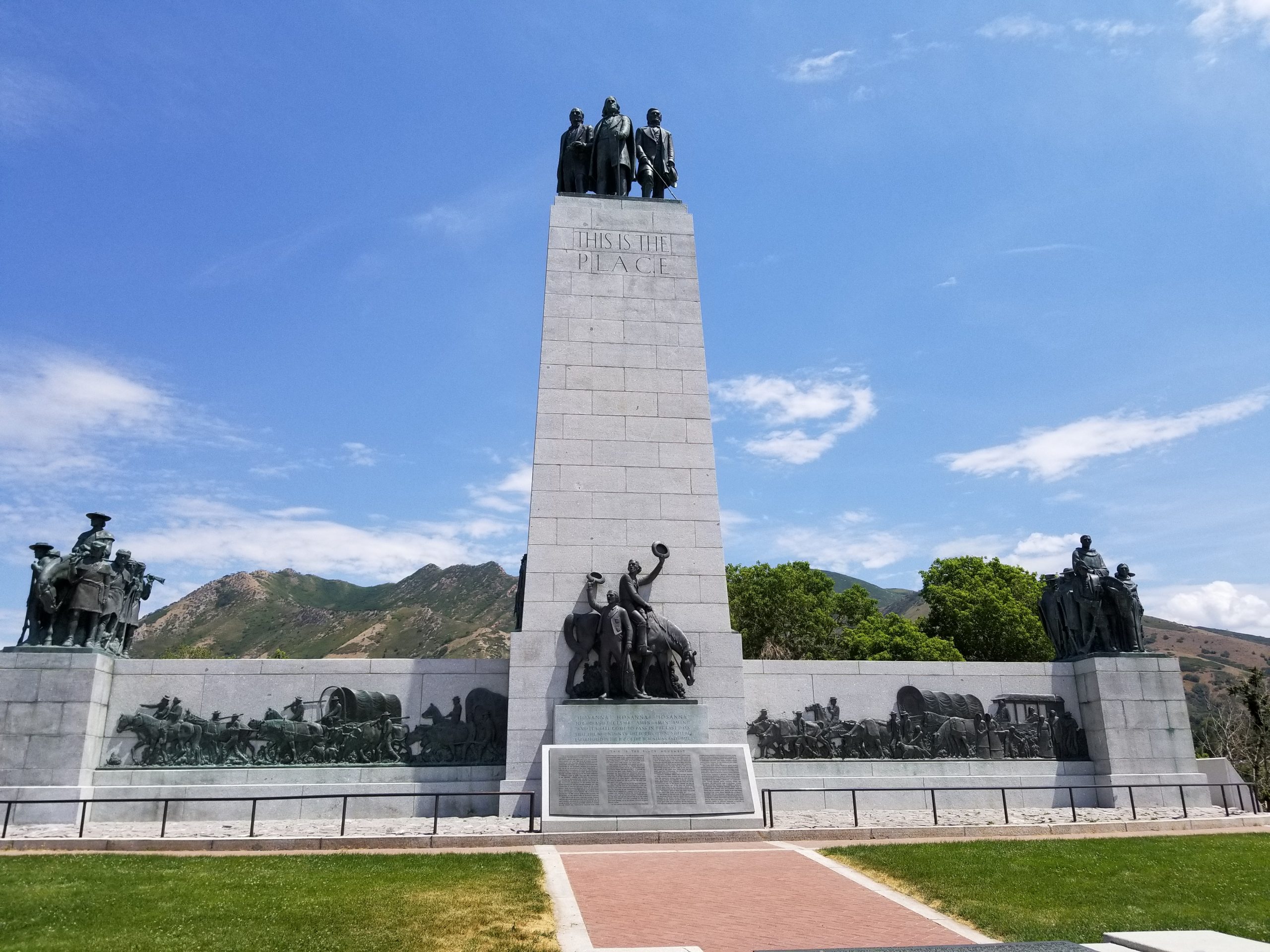
The building was rewired for electricity in the 1960s, and bathrooms were installed in the area under the exterior staircase. The small attic room (commonly called “The Prayer Room”) was also completed. In 1971, the Pine Valley Chapel was listed on the U.S. National Register of Historic Places. In 1998, a replica of the Meetinghouse was built and is found at This is the Place Heritage Park.

Additional information at the site.

The chapel received a seismic upgrade from 2000 to 2004, in which all of the windows, siding, roof and exterior siding were replaced. There were also some interior cosmetic fixes. The chapel was dedicated on May 15, 2005 by Elder Jeffrey R. Holland.

For Further Reference:

Secondary Sources:

Elder Jeffery R. Holland rededicates a chapel in Pine Valley, Utah. Spectrum (St. George, Utah), 2005 May 16.

Jensen, Cory. Ebenezer Bryce served an apprenticeship in shipyards in his native Scotland. After joining the Church and emigrating to Utah, he began construction on the chapel in Pine Valley, completing the building in 1867. Folklore about the building states that Bryce built the building like a ship. No documentation has been found to support this folklore. Heritage (Utah Heritage Foundation Newsletter). Vol. 35: No. 1 (Winter 2001), page(s) 16-17.

Utt, Emily. Pine Valley Meetinghouse and Tithing Office Statement of Significance, (2010).

Deseret News Publishing Company (2016). Beautiful little chapel. Retrieved from http://www.ldschurchnewsarchive.com/articles/47348/Beautiful-little-chapel.html

National Park Service (n.d.). National Register of Historic Places. Retrieved from http://npgallery.nps.gov/nrhp/AssetDetail?assetID=77dc0603-6087-4f56-a4bc-7b5d4508b730

Pine Valley Record. Records. Church History Library, Salt Lake City, Utah [LR 6941 2 FILMING 2]

This is the Place Heritage Park (2016). Pine Valley Chapel. Retrieved from http://www.thisistheplace.org/heritage-village/buildings/pine-valley-chapel.html

 http://loc.gov/pictures/item/md1633/

https://en.wikipedia.org/wiki/Pine_Valley_Chapel_and_Tithing_Office

Additional photos:

Interior view of the rafters.

Inside the chapel, ceiling fixtures.

Winter Home of Brigham Young

Published / by admin / 2 Comments on Winter Home of Brigham Young

write-up by Alan Johnson

Placed by: Daughters of the Utah Pioneers, No. 98
GPS Coordinates: 37°6′41″ N, 113°35′6″ W

Historical Marker Text: During construction of the St. George Temple, pres. Brigham Young found the climate in this facility beneficial to his health, and decided to have a winter home built in St. George. On December 15, 1873 he arrived from the north and moved into his new house, though still unfinished. Later he had an office built east of his home where he took care of his various duties both here and in the north. The winters which followed until his death in 1877 were enjoyed in this winter home.

Photo Credit: LDS.org (accessed on 9.19.16)

Extended Research:

 In March 1872 Brigham Young purchased the home that came to be known as the Brigham Young Winter Home. The back portion of the home was built by James Chesney in about 1866 and sold to Henry W. Lawrence in about 1868. Lawrence sold the home to Brigham Young Jr. in 1871, and Brigham Jr. then sold it to his father. The home was remodeled, more than doubling it in size to better serve President Young’s needs. Joseph W. Young, nephew of Brigham Young, was the first building contractor on the remodel. He corresponded frequently with Brigham about progress on the house, as Brigham was in Salt Lake City during most of the remodeling project. Unfortunately, Joseph died in June 1873 in the midst of the home remodel.

Brigham Young’s winter home was completed in 1874. The architect of the original structure was Miles Romney. His son, Miles P. Romney, designed the addition. The roofs are gabled and the cornices are bracketed, a style common in Utah and apparently related to the architectural style popular in Nauvoo period in Illinois during the early 1840’s. Much of the original wood remains in the home. Skilled artisans took pine, hardened it and grained it to look like oak. The local description is “Brigham Oak.”[1]

After Brigham Young’s death, members of the Young family owned the Winter Home until 1892, when it was sold to Jedediah Morgan Gates. Gates was a dentist and operated a successful practice from the home for many years. The home underwent major renovation to accommodate Gates’ family and practice. In 1955, Gates’s daughters sold the home to the Brigham Young Memorial Association. The association hoped to restore the home but found it a larger task than they could handle. Subsequently, the family association sold it to the state of Utah in 1959. The state completed the first of several restoration projects and operated the home as a state historic site for a number of years. The structure at the back of the property, now used for storage and restrooms, was completed in 1971. In 1974, The Church of Jesus Christ of Latter-day Saints acquired the home for use as a Church historic site. The home was dedicated as a Church historic site May 29, 1976, by Elder L. Tom Perry. Since that time, the home has undergone additional restorations, including efforts to bring paint colors and furnishings from Brigham Young’s time into the home.[2]

Because he headed South and managed to avoid the cold of the North during the winter months, it could be said that Brigham Young was one of Utah’s first snowbirds.

[1] http://focus.nps.gov/pdfhost/docs/NRHP/Text/71000863.pdf. Accessed on 9.19.16

[2] Some of this content comes from internal training materials produced by the Church History Department of The Church of Jesus Christ of Latter-day Saints.


For Further Reference:

Primary Sources:

Brigham Young Winter Home and Jacob Hamblin Home: Dedicatory Services, Church History Library, The Church of Jesus Christ of Latter-day Saints, M255.88 C561b 1976.

Secondary Sources:

Spencer, Clarissa Young, with Mabel Harmer. Brigham Young at Home. Salt Lake City: Deseret Book, 1940. A delightful account of life in Brigham Young’s Salt Lake household as seen through the eyes of a daughter.

http://www.deseretnews.com/article/765617684/Brigham-Youngs-winter-home-Residence-offers-visitors-glimpse-into-the-life-of-the-American-Moses.html?pg=all

http://utah.com/mormon/brigham-young-winter-home

https://en.wikipedia.org/wiki/Brigham_Young_Winter_Home_and_Office